What Size Gutters Does a Rhode Island Home Need?
Guide to choosing 5-inch vs 6-inch K-style gutters, downspout sizing, and guards for Rhode Island's heavy rain and snow.
Picking the right gutter size for your Rhode Island home is crucial to avoid water damage caused by the state’s 47 inches of annual rainfall and intense storms with rainfall rates of 2.3 inches per hour. Here's the short answer:
- 5-inch K-style gutters are suitable for smaller homes with moderate roof pitches, handling up to 5,520 sq. ft. of roof drainage.
- 6-inch K-style gutters are better for larger homes, steep roofs, or heavy rainfall areas, managing up to 7,960 sq. ft. and offering 40% more capacity than 5-inch systems.
For optimal performance, pair gutters with properly sized downspouts and consider gutter guards to prevent clogs. Correct sizing and installation ensure your system handles Rhode Island’s unpredictable weather, including nor’easters, snow, and ice dams.
Keep reading for detailed sizing calculations, installation tips, and maintenance advice.
Tips For Properly Sizing a Rain Gutter System
sbb-itb-634c8b2
Rhode Island's Climate and Rainfall Patterns
Rhode Island’s location near the jet stream brings a mix of cold, dry winters and warm, humid summers, resulting in unpredictable weather. This variability stems from colliding air masses that create ever-changing conditions.
The state sees an average of 46 to 47 inches of precipitation annually, though local rainfall can differ by as much as 10 inches due to geographic factors. Seasonal shifts also play a big role in precipitation. March is typically the wettest month, with rainfall ranging from 4.90 to 5.59 inches depending on the area. Providence has even recorded extreme rainfall totals during heavy rain events. On the flip side, July is generally the driest month, averaging less than 3 inches of rain. Winter snow adds another layer of complexity, with coastal areas receiving 20 to 40 inches annually, while western Kent and Providence Counties see 40 to 60 inches. This heavy snow increases the likelihood of ice dams forming, especially if gutters are undersized.
Recent years have brought more frequent extreme rainfall events. Between 2005 and 2014, Rhode Island saw its highest number of 2-inch rainfall events on record. The state’s wettest year, 1972, brought 63 inches of precipitation, while its driest year, 1965, saw only 28 inches - a dramatic 35-inch difference that highlights how unpredictable the region’s weather can be.
Gutter systems in Rhode Island must handle both the steady impact of an annual 47 inches of rain and the intense bursts of storms that can deliver rain at rates of up to 2.3 inches per hour. Coastal homes face unique challenges, such as nor’easters and salt air that speed up corrosion. Meanwhile, inland properties deal with heavier snow loads and frequent freeze-thaw cycles, which can strain gutter hangers and seals.
Choosing a gutter system that can endure Rhode Island’s demanding climate is essential. These weather patterns make it critical to calculate your roof’s drainage needs accurately, as we’ll discuss next.
Standard Gutter Sizes and Their Applications
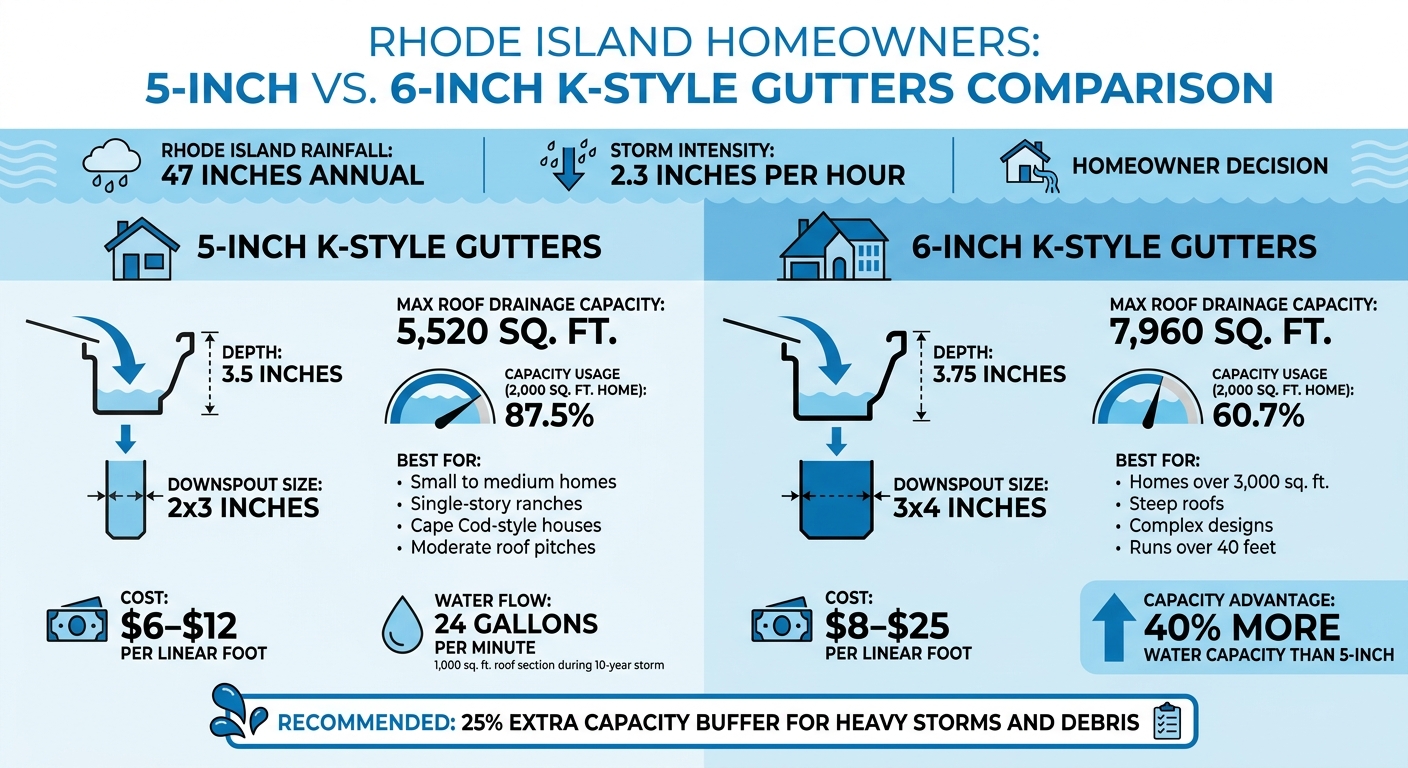
5-Inch vs 6-Inch Gutter Comparison for Rhode Island Homes
In Rhode Island, K-style gutters are the go-to choice for most homes due to their efficient design. These gutters typically come in two residential sizes - 5-inch and 6-inch - each performing differently during heavy rain. Knowing how these sizes handle Rhode Island's frequent storms can help you pick the right system to avoid overflow and potential damage.
The size of your gutters should match your roof's square footage, pitch, and complexity. For example, a 5-inch K-style gutter can handle up to 5,520 square feet of roof under Rhode Island's rainfall intensity of 2.3 inches per hour. For a standard 2,000-square-foot home, this means the gutter operates at about 87.5% of its capacity during a typical 10-year storm. On the other hand, a 6-inch K-style gutter can manage up to 7,960 square feet, operating at just 60.7% capacity under the same conditions.
"Though a 6″ gutter is only an inch bigger than a 5″, it can handle 40% more water." – Brothers Gutters
To put this into perspective, a 1,000-square-foot roof section sheds roughly 24 gallons of water per minute during a 10-year storm. The added capacity of 6-inch gutters offers a buffer against unexpected downpours or minor blockages.
5-Inch K-Style Gutters
These gutters are 3.5 inches deep and typically paired with 2x3-inch rectangular downspouts. They are ideal for small to medium-sized homes, such as single-story ranches or Cape Cod-style houses, where moderate roof pitches and asphalt shingles help slow water runoff.
Costing between $6 and $12 per linear foot, 5-inch gutters are an economical option. However, signs like overflow, water marks on siding, or fascia board separation may indicate that the gutters are undersized for the home. For larger or more complex roofs, 6-inch gutters may be a better fit.
6-Inch K-Style Gutters
With a depth of 3.75 inches, 6-inch gutters use larger 3x4-inch downspouts. These are better suited for homes over 3,000 square feet, steeply pitched roofs, or complex designs that direct water to specific areas. They’re also ideal for longer gutter runs - especially those over 40 feet or total runs exceeding 60 feet - where a single downspout might not be sufficient.
Steep roof pitches and smoother metal surfaces increase water runoff speed, which 6-inch gutters can handle more effectively. Installation costs range from $8 to $25 per linear foot, depending on the material. While the upfront cost is higher, this size helps prevent water damage in Rhode Island's challenging climate, which includes salt air and freeze-thaw cycles. Plus, their larger capacity ensures they keep working even with some debris or ice buildup.
Calculating the Right Gutter Size for Your Roof
To figure out the correct gutter size for your roof, you’ll need to consider its square footage, pitch, and Rhode Island's design rainfall intensity of 2.3 inches per hour. This moderate rainfall rate - ranking 36th in the nation - can strain undersized gutters during intense storms.
Start by calculating your roof's square footage, adjust for its pitch, and then multiply by the 2.3 in/hr rainfall intensity. For example, a typical 2,000-square-foot home with a 4/12 pitch has an effective drainage area of about 2,160 square feet. Multiplying this by 2.3 gives an adjusted area of approximately 4,968 square feet. A 5-inch K-style gutter, which handles about 5,520 square feet of drainage, would operate at roughly 87.5% capacity under these conditions. To ensure smooth operation during heavier storms or minor clogs, aim for gutters with at least 25% extra capacity. Next, let’s break down how to measure your roof's area accurately.
Measuring Roof Square Footage
To measure your roof, work section by section. Use a tape measure to find the length and width of each plane, then multiply these numbers to determine the square footage. For a symmetrical gable roof, you can measure one side and double it. If safety is a concern, you can measure your home's footprint from the ground and adjust for the typical 12–18 inch overhangs.
If your upper roof gutters drain into lower ones, remember to size the lower gutters to handle the combined drainage area of all contributing sections.
How Roof Pitch Affects Gutter Size
Roof pitch is a key factor in gutter sizing because steeper roofs shed water faster and collect more wind-driven rain. To measure pitch, place a 12-inch level horizontally on the roof and measure the vertical drop at its end.
"If you have a steeper roof pitch, there's a high risk for rain to collect in your gutters. You'll want to size up your gutters because rain will be running off the gutters at a faster pace."
– Jose Figueroa, Gutter Expert, Artisan Quality Roofing
You’ll need to adjust your roof’s measured area to account for pitch using a pitch multiplier. For instance, a roof with a 4/12 pitch might increase its effective area by 5%, while steeper pitches over 9/12 may require larger gutters, such as 6-inch models, to handle the higher water volume and speed.
| Roof Pitch (Rise per 12" Run) | Pitch Multiplier |
|---|---|
| 0–3 inches | 1.0 |
| 4–5 inches | 1.05 |
| 6–8 inches | 1.1 |
| 9–11 inches | 1.2 |
| 12+ inches | 1.3 |
Matching Gutter Sizes with Downspouts
Once you've figured out the right gutter size, the next step is to pair it with downspouts that can handle the system's capacity. Gutters and downspouts need to work together to manage water effectively. For example, standard 5-inch K-style gutters typically pair with 2x3-inch downspouts, while 6-inch K-style gutters require 3x4-inch downspouts to handle the larger water volume. If you're using half-round gutters, you'll need circular downspouts: 5-inch gutters pair with downspouts ranging from 3 to 5 inches in diameter, and 6-inch gutters need downspouts between 4 and 6 inches in diameter.
| Gutter Type | Gutter Size | Recommended Downspout Size |
|---|---|---|
| K-style | 5 inches | 2x3 inches |
| K-style | 6 inches | 3x4 inches |
| Half-round | 5 inches | 3–5-inch diameter |
| Half-round | 6 inches | 4–6-inch diameter |
To keep everything running smoothly, install one downspout every 25 to 35 linear feet of gutter, ensuring no section exceeds 40 feet without a downspout. This spacing is critical for avoiding overflow and sagging during heavy storms.
When installing, make sure the gutter outlet fits securely into the downspout to create a leak-resistant seal. You can also use gutter extensions to direct water away from your home's foundation as needed.
Proper guard installation is key to avoiding costly issues like water damage or sagging gutters. In areas like Rhode Island, where weather conditions and rainfall can be unpredictable, professional installation can make a big difference. According to surveys, 12% of homeowners report drainage issues, often caused by incorrect sizing, while 26% experience sagging, usually due to poor installation.
Improving Gutter Performance with Gutter Guards
Even gutters that are the right size for your home can fail if they get clogged. Gutter guards are designed to block leaves, twigs, and other debris while allowing water to flow freely. This is especially crucial in Rhode Island, where frequent rain and heavy tree coverage create the perfect conditions for clogs.
When gutters clog, they struggle to handle even normal rainfall, let alone the intense storms that occasionally hit the area. Overflowing gutters can lead to damage to your foundation, fascia, and landscaping. Gutter guards help prevent this by keeping debris out, ensuring proper drainage. They also reduce the risk of ice dams during Rhode Island's cold winters, a problem that can cause significant roof damage.
Another benefit of gutter guards is reduced maintenance. Without them, experts recommend cleaning your gutters at least twice a year. Installing guards can drastically cut down on this chore. While the cost of gutter guard installation ranges from $1 to $7 per linear foot, it’s a small investment compared to the expense of repairing water damage. Professional installation is especially important to ensure the guards are properly aligned and functioning as intended.
If you have a 6-inch gutter system, adding guards allows it to handle 40% more water than a 5-inch system, all without being compromised by debris. However, improper installation can interfere with your roof shingles or disrupt the gutter's drainage slope. That’s why hiring professionals like Downspout Services is essential - they ensure your gutter guards are correctly aligned, providing your home with better protection against Rhode Island's unpredictable weather.
Conclusion
When sizing your gutters, consider your roof dimensions alongside Rhode Island’s weather patterns, which include 47 inches of annual rainfall and storms with 2.3 inches per hour of intensity. For a typical 2,000-square-foot home, standard 5-inch gutters often suffice. However, homes with steeper roof pitches or intricate rooflines may require 6-inch gutters to handle faster water runoff and concentrated flow. Properly sized gutters safeguard your foundation, prevent flooding, and mitigate issues like ice dams and nor’easters.
Efficient drainage also depends on pairing your gutters with correctly sized downspouts, spaced every 25 to 35 linear feet. This ensures water is directed away from your home during even the most intense storms. Additionally, using durable materials like aluminum or copper is essential for coastal Rhode Island properties, as these materials resist corrosion in salty air, extending your gutter system’s lifespan.
For peace of mind and a system tailored to your home’s specific needs, consult professionals like Downspout Services. They can evaluate your roofline, pitch, and drainage patterns to recommend the best solutions. With expert guidance, you can avoid costly water damage and ensure your home remains protected, even during Rhode Island’s heaviest rainfalls.
FAQs
Should I choose 5-inch or 6-inch gutters for my Rhode Island home?
For most homes in Rhode Island, 5-inch gutters typically work well, accommodating standard rainfall and average roof sizes. That said, if your home features a larger or more complex roof design, or if you live in an area prone to heavy rainfall, 6-inch gutters might be the better choice. These larger gutters are designed to manage higher water volumes, helping to prevent overflows and minimize the risk of water damage during intense storms.
How do I calculate my roof’s effective drainage area?
To figure out your roof's effective drainage area, you'll need to account for its size, pitch, and Rhode Island's local rainfall intensity of 2.3 inches per hour. Start by measuring the roof's area, then adjust it using a pitch factor if necessary. Multiply this adjusted area by the rainfall intensity to get an idea of the drainage requirements. For a more accurate result, consider using a gutter sizing calculator that factors in your roof's specific dimensions and local conditions.
How many downspouts do I need, and what size should they be?
The number of downspouts your home needs depends on the size of your roof and the amount of rainfall it must manage. For example, in Rhode Island, a 1,000 sq. ft. roof typically requires around five downspouts, while a 1,750 sq. ft. roof may need six. Most homes can use standard 5-inch gutters, but if your roof is larger or you experience heavy rainfall, 6-inch gutters and larger downspouts might be a better choice. For the most accurate advice, it’s always a good idea to consult a professional.