When Should You Seal Pavers Before Winter in Rhode Island?
Seal pavers in early Sept–early Oct when temps stay 50–80°F, surfaces are dry, and you have a 24–72 hour rain‑free cure.
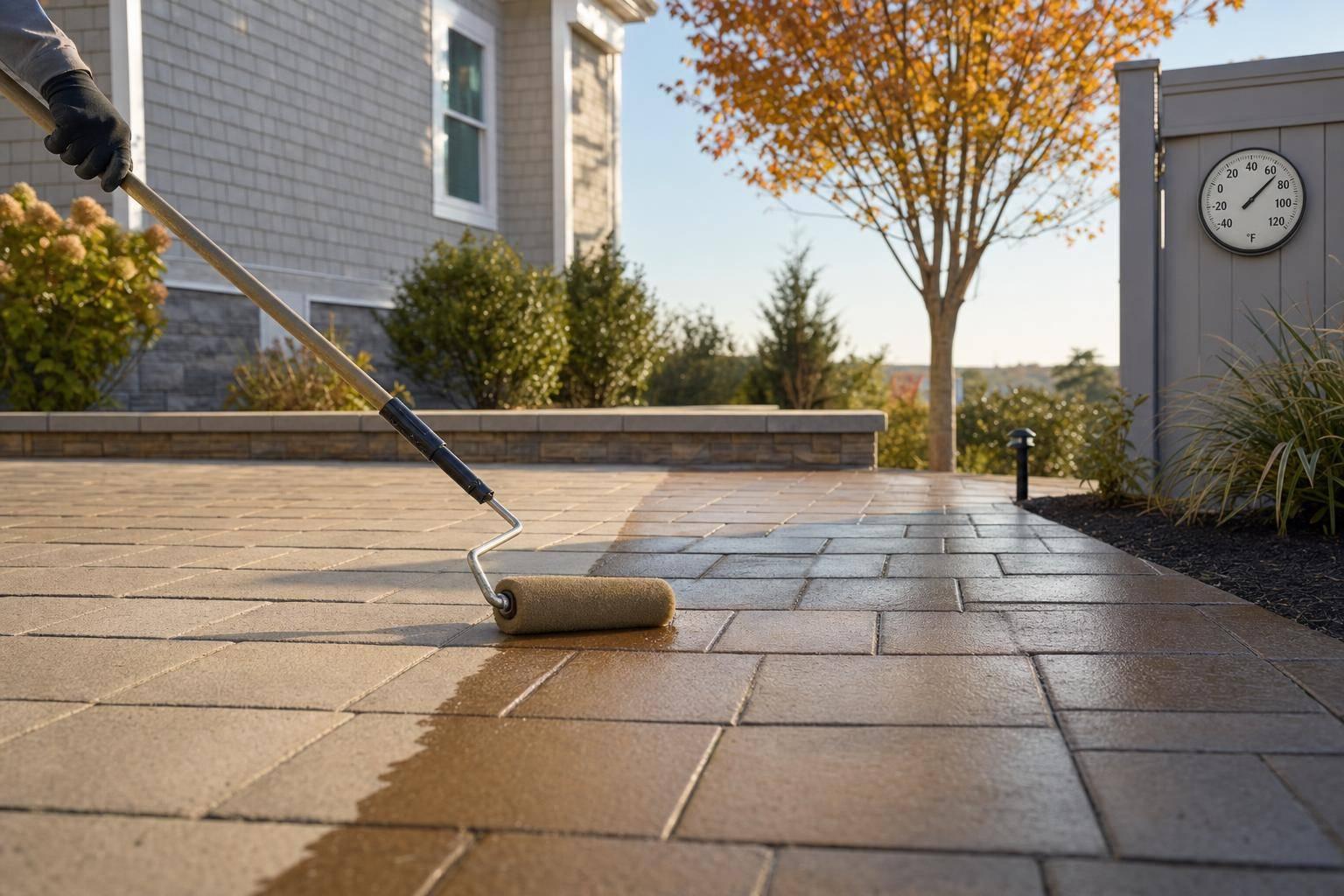
In Rhode Island, the best time to seal pavers before winter is usually early September through early October. That timing gives you the best shot at 50°F to 80°F conditions, a dry 48- to 72-hour cure window, and enough time before freeze-thaw stress kicks in.
If you wait too long, cold nights, dew, rain, and trapped moisture can ruin the sealer. That matters in a state that gets about 40 freeze-thaw cycles each winter. Near the coast, salt air, humidity, and de-icing runoff can shorten your weather window even more.
Here’s the short answer:
- Aim for early fall, not late fall
- Seal only when pavers are fully dry
- Check both daytime highs and overnight lows
- Avoid rain during the full cure period
- Skip sealing if temps may drop below 50°F before curing ends
- Wait 24 to 72 dry hours after washing
- Wait 30 to 90 days for new pavers
- Wait 28 to 30 days after polymeric sand installation
A fixed frost date is not enough. Your sealing day should be based on the forecast, surface dryness, and cure time.
| Factor | What to Look For | What It Means for You |
|---|---|---|
| Best seasonal window | Early September to early October | Best chance for safe curing |
| Air temperature | 50°F to 80°F | Below that, curing can fail |
| Surface condition | Fully dry | Damp pavers can trap moisture |
| Rain forecast | No rain for 24 to 72 hours | Rain can damage uncured sealer |
| Overnight lows | Stay above product minimum | Cold nights can leave haze or weak bonding |
| Coastal exposure | High humidity, salt air | Drying may take longer |
The rest of the article explains how to spot a safe sealing window before winter closes it.
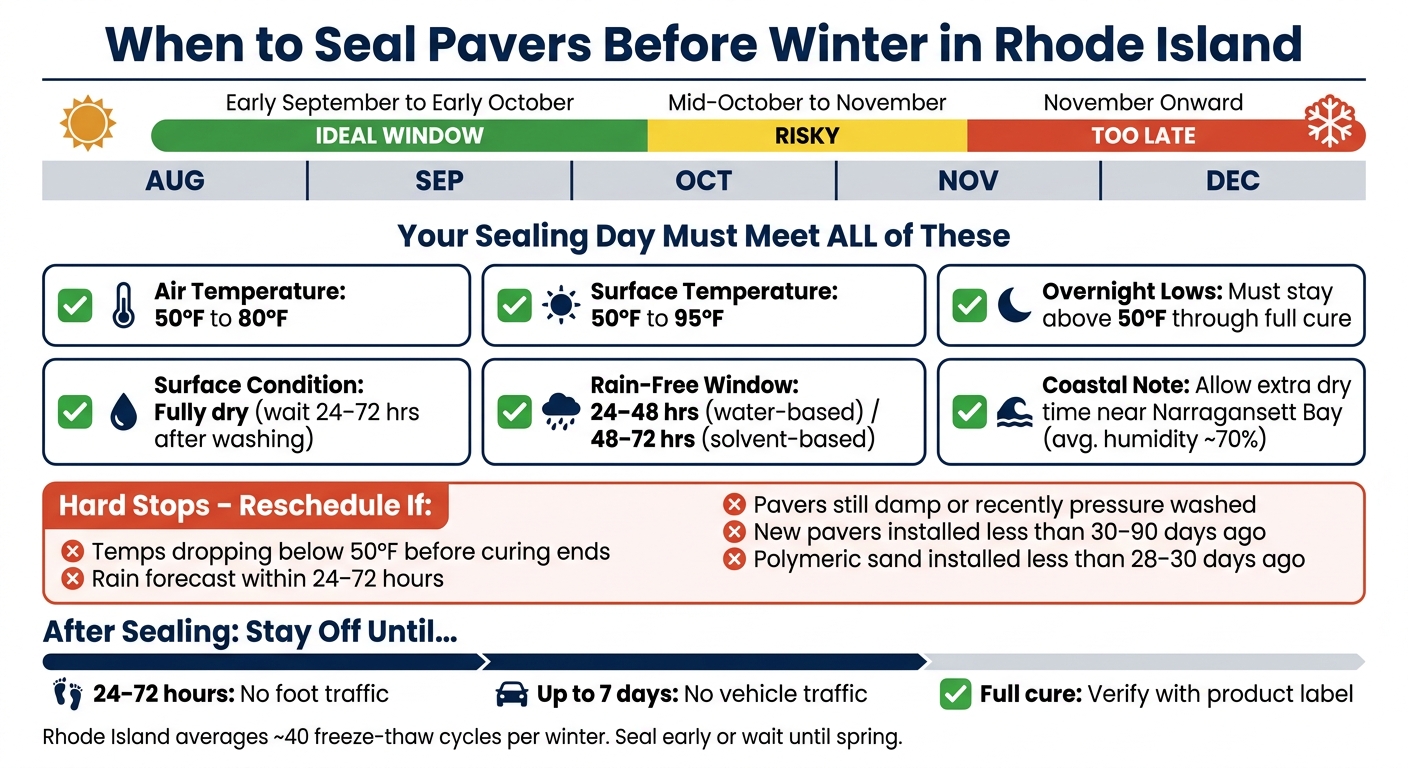
When to Seal Pavers Before Winter in Rhode Island: A Go/No-Go Guide
The best fall window for sealing pavers in Rhode Island
In Rhode Island, the most practical time to seal pavers is usually early September through early October, when temperatures still allow curing and dry stretches show up more often. After mid-October, that window can shrink in a hurry. Nights get too cold for proper curing, and Nor'easters can throw off the schedule. By November, sealing is often too risky. Temps can sit near the product minimum, heavy dew becomes a bigger problem, and the first hard frost is getting close, which makes a clean cure window tough to count on.
That’s why the calendar only tells part of the story. Site conditions matter just as much.
Near the coast, humidity and salt air can shorten the workable window. Shaded patios can also stay damp longer, especially spots under furniture or planters. So even if you’re inside that September-to-early-October stretch, you may still lose usable days. At that point, the key issue is simple: does the weather stay inside the product’s temperature range long enough for the sealer to cure?
Use weather conditions, not a fixed frost date
Do not rely on a first-frost date by itself. Frost timing changes from year to year, and it can look different in coastal and inland parts of Rhode Island. A frost-date rule is too blunt for this state.
What matters more is the weather right in front of you: the temperature range, whether the surface is fully dry, and how steady the forecast looks over the next 48 to 72 hours. That’s the stuff that decides whether a sealing day works or falls apart.
Look for mild, dry days within the sealer's temperature range
Most paver sealers list an application range of 50°F to 80°F. But air temperature is only one piece of it. The paver surface also needs to stay in that range. If the surface gets too hot, the sealer can dry too fast and fail to bond well.
Rhode Island fall nights cool down fast. An afternoon high of 65°F may look fine, but if the overnight low drops below 40°F to 50°F soon after application, curing can get interrupted. That’s why the overnight forecast matters just as much as the daytime high.
Water-based sealers usually need a 24 to 48 hour rain-free window to cure. Solvent-based products can need 48 to 72 hours. In coastal Rhode Island, where average humidity is around 70%, that window can feel tighter than the forecast makes it seem. Only start when the pavers are fully dry. A clear sky doesn’t always mean the surface is ready.
sbb-itb-634c8b2
How temperature, rain, and cure time determine whether a day is right for sealing
Once you know your fall timing, the next step is simple: check the forecast and see if the sealer can cure without problems.
Check temperature from application through the full cure period
Most sealers need 50°F to 80°F air temperatures and 50°F to 95°F surface temperatures. Those numbers don’t just matter when you start. They need to stay in range for the full curing period. If the surface is hotter than 95°F, the sealer can flash-dry too fast and leave streaks. If the surface drops below 50°F before curing is done, the film may not form the way it should.
That’s why the overnight forecast matters as much as the daytime high. If temperatures are set to fall below the product minimum before cure time is over, it’s better to wait.
Keep the surface dry before and after sealing
Dry conditions matter on both sides of the job: before application and during cure time.
Pavers need to be fully dry before any sealer is applied. If moisture is still sitting in the joints or under the surface, you’re asking for trouble. After sealing, the forecast also needs to stay dry for the full cure window:
- Water-based sealers: 24 to 48 hours
- Solvent-based sealers: 48 to 72 hours
High humidity and overnight dew can slow drying and curing. They can also leave the finish cloudy. In coastal Rhode Island, that risk is hard to ignore. Average humidity sits around 70%, and dew plus salt air can become a late-fall problem, especially near Narragansett Bay.
A simple field check helps here. If water soaks into the surface, the pavers are ready. If it beads up, wait longer.
Weather and traffic conditions: a scheduling reference table
Use the table below as a final go/no-go check.
| Condition | Why It Matters | Action to Take |
|---|---|---|
| Air temp below 50°F | Prevents proper chemical bonding and curing | Postpone sealing until a warmer window is available |
| Surface temp above 95°F | Causes sealer to flash-dry unevenly, leaving streaks | Seal in the morning or on a cooler, overcast day |
| Drying after cleaning | Trapped moisture can cause peeling, flaking, or hazing | Wait until the pavers are fully dry |
| Rain forecast within cure window | Rain can ruin uncured sealer | Reschedule if rain is predicted during the cure period |
| Overnight moisture or dew | Slows curing and can weaken adhesion | Avoid sealing if high humidity, dew, or frost is expected overnight |
| Foot traffic | Walking on uncured sealer can mar the finish | Keep off for 24 to 72 hours |
| Vehicle traffic | Tires can damage a fresh seal | Wait up to 7 days before driving on it |
When fall sealing should be postponed
Hold off on sealing if the forecast won't stay dry and above the product minimum for the full cure period.
Postpone if freezing weather or rain could interrupt curing
Treat these as hard stops. Postpone sealing if temperatures are set to drop below 50°F during application or before curing is done, or if rain is in the forecast during the cure window. Even one cold night below that mark can leave the finish cloudy or not fully cured.
Rain is the other clear deal-breaker. If there's any chance of precipitation within 24 to 72 hours, move the job to another day. The same goes for heavy morning dew or condensation that just won't dry up.
Postpone if pavers are damp or not ready for sealing
Moisture in the pavers is the next cutoff. If the surface was pressure washed not long ago, wait 24 to 72 dry hours before sealing.
New pavers need 30 to 90 days before sealing. That gives efflorescence time to clear before sealer goes on. If polymeric sand was installed recently, the joint material needs at least 28 to 30 days to cure fully.
Timing matters after application too. If the area can't stay clear for the full cure period, it's better to delay sealing.
A before-winter checklist for Rhode Island paver sealing
A simple checklist to run before scheduling sealing
Before you book a paver sealing job, go through these checks in order. If even one of them doesn’t line up, the finish can go sideways.
- Check the label first. Make sure the temperature range works, then confirm both daytime highs and overnight lows will stay inside that range for the full cure period.
- Confirm the surface is dry. If it rained recently or you pressure washed the area, the pavers need 24 to 72 hours to dry before sealer is applied.
- Verify joint sand is ready. Polymeric sand needs at least 28 to 30 days to cure before sealing. Standard sand should be filled to the proper level.
- Schedule a rain-free cure window. Try to get a dry stretch that matches the product label, often 48 to 72 hours after application. Check the forecast again the morning of the job, not just the night before.
- Account for shade and coastal humidity. Shaded spots and homes near Narragansett Bay tend to dry more slowly. Near the coast, give the surface extra time.
- Keep vehicles off until the label's full cure time ends.
If any item fails, reschedule.
Conclusion: Freeze-thaw conditions do not wait for a convenient schedule
Once the checklist is clear, don’t sit on it. Rhode Island’s freeze-thaw cycle can shut the window fast. Each cycle puts stress on paver surfaces, and freezing moisture can force pavers and joints apart. If you seal too late, the product may not bond well, and the finish can fail before winter even starts.
Forget rigid calendar rules. Go for a mild, dry stretch in early fall, while temperatures are still inside the sealer’s recommended range. Book the job only when the forecast gives you that dry, mild window.
FAQs
What if you miss the early fall sealing window?
If you miss that early fall window, don’t seal once frost shows up and the weather turns cold for good. Sealers need a few dry days in a row with temperatures staying above 40°F to cure the way they should.
Try to seal in late fall or winter, and things can go sideways fast. You may end up with uneven drying, streaks, or a coating that fails before it should. If the timing slips, the better move is to wait until late spring or early summer, when the ground and the surface are dry and temperatures have warmed up for good.
How do I know if my pavers are dry enough to seal?
Wait 24 to 72 hours after cleaning or rain before sealing, and make sure the weather stays dry during that time.
Here’s why: even when the surface looks dry, moisture can still sit inside the pavers. If you seal too soon, that trapped moisture can leave a white, milky haze under the sealant.
A simple way to check is with a water test:
- If water beads up, the pavers need more time to dry.
- If water soaks in evenly, they’re dry enough to seal.
Does sealing before winter help prevent freeze-thaw damage?
Yes. Sealing pavers before winter helps cut down freeze-thaw damage by filling tiny surface pores and reducing how much water the pavers soak up.
In Rhode Island, that matters a lot. Water that gets into pavers can freeze, expand, and then thaw again as temperatures swing. Over time, that repeated cycle can lead to cracking, spalling, and heaving.
A high-quality, breathable, penetrating sealer helps by blocking water and salt while still letting trapped moisture escape. That balance is key. You want protection from winter weather without sealing moisture inside the paver.
Related Blog Posts
Heading 1
Heading 2
Heading 3
Heading 4
Heading 5
Heading 6
Lorem ipsum dolor sit amet, consectetur adipiscing elit, sed do eiusmod tempor incididunt ut labore et dolore magna aliqua. Ut enim ad minim veniam, quis nostrud exercitation ullamco laboris nisi ut aliquip ex ea commodo consequat. Duis aute irure dolor in reprehenderit in voluptate velit esse cillum dolore eu fugiat nulla pariatur.
Block quote
Ordered list
- Item 1
- Item 2
- Item 3
Unordered list
- Item A
- Item B
- Item C
Bold text
Emphasis
Superscript
Subscript