What Color Gutters Work Best on Rhode Island Homes
White, charcoal, or earth-tone gutters work best for Rhode Island homes—match trim or contrast, and choose factory-finished aluminum for coastal durability.
For most Rhode Island homes, the safest gutter colors are white, charcoal, and earth tones - and the right pick depends on whether you want the gutters to blend in or stand out.
Your gutter color matters more than many homeowners think because most houses have 150 to 200+ linear feet of visible gutters. In Rhode Island, salt air, bright coastal sun, and winter freeze-thaw cycles can make the wrong finish look dirty or worn faster. In simple terms, white works well with white trim, black or charcoal works well with black windows or dark roof edges, and bronze or brown fits cedar, stone, or brick exteriors.
Before choosing a color, focus on these points:
- Match the fascia if you want the gutter line to fade back
- Match the trim if you want a clean, sharp border
- Use contrast if you want to outline the roofline
- Choose factory-finished aluminum for better color hold in coastal weather
- Know that light colors show dirt faster
- Know that dark colors hide streaks better but can show salt residue more
Quick answer: if your home is Colonial or Cape-style, white or cream is often the safest route. If your home has black accents or a modern look, black or charcoal often fits better. If your exterior has cedar shingles, stone, or warm siding, bronze and brown are often the better match.
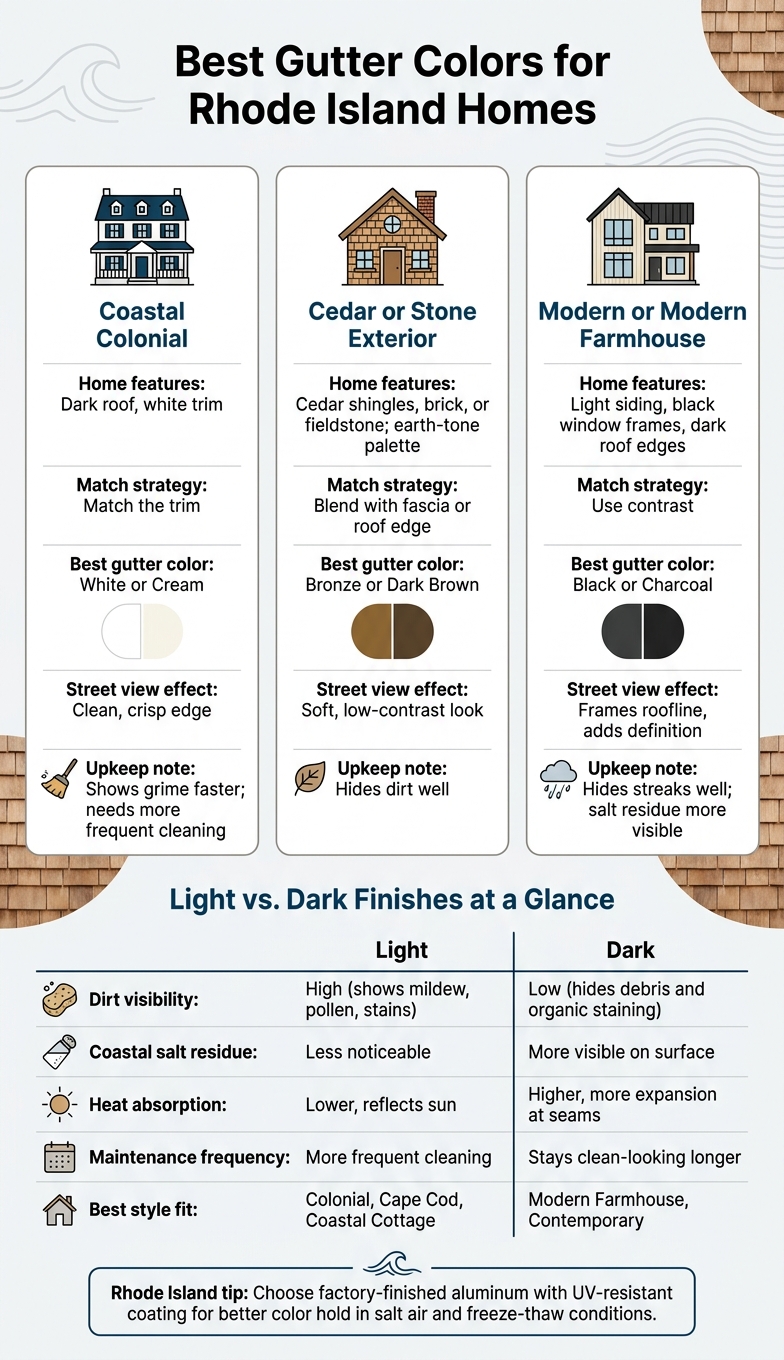
Best Gutter Colors for Rhode Island Homes by Style & Finish
How to Choose Gutter Colors
sbb-itb-634c8b2
Quick Comparison
| Home look | Best color direction | Street view effect | Upkeep note |
|---|---|---|---|
| White trim + dark roof | White or cream | Clean, crisp edge | Shows grime faster |
| Light siding + black windows | Black or charcoal | Strong roofline outline | Hides streaks well |
| Cedar, brick, or stone | Bronze or brown | Soft, low-contrast look | Usually hides dirt well |
| Coastal cottage palette | White, light gray, or navy | Bright, simple finish | Light shades need more cleaning |
The main goal is simple: choose a gutter color that fits your trim, roof, and siding as one set, then pick a finish that can handle Rhode Island weather.
Rhode Island home styles, color palettes, and local rules to know first
Rhode Island homes come in a wide mix of styles, from Colonials and Cape Cods to coastal cottages and modern farmhouses. And each one tends to point you toward a different starting color for gutters. After that, the big call is simple: should the gutters blend into the trim, or should they trace the fascia line and stand out a bit more?
Common exterior color combinations seen across Rhode Island
Colonials often look best with white gutters, white trim, and a dark roof, which creates a crisp edge.
Cape Cod and coastal homes usually pair well with white, navy, or light-gray gutters.
Modern and modern farmhouse exteriors often look best with black or charcoal gutters set against light siding .
A good rule of thumb: use gutters that match the trim when you want a clean, unified look. If you want downspouts to fade into the background, match them to the main house color instead.
Before you go with a bold contrast, check your local rules first. In Rhode Island historic districts, color choices may need to fit the home's original architectural period, and lower-contrast, period-fit options are often required. HOA rules can do the same in newer neighborhoods.
Once you know what rules apply, you can decide between trim-matching gutters and a stronger contrast. From there, it comes down to the finish and color family, which matters even more in Rhode Island's coastal climate.
Match the trim, match the roofline, or go with contrast: how to decide
The main call comes down to this: should the gutters fade into the fascia, follow the trim, or stand out as a design line?
When matching the fascia or trim gives the cleanest result
When both fascia and trim are visible, match the line you want to visually disappear. If the fascia and trim are the same color, use that color. If they’re different, start with the fascia because the gutter sits right against it. Go with the trim instead when the trim package is the detail you want people to notice, and you want the gutter to feel like part of that feature.
As Mountain View Exteriors notes, matching fascia or trim keeps the gutter line quiet and helps corners disappear.
Light finishes tend to show dirt, mildew, and streaking more easily than darker tones. That matters in Rhode Island’s coastal climate, where salt air and moisture can be tough on exteriors. And in bright seaside light, close color matches are easier to spot, so the closer the match, the better.
That said, if the home already has black windows, dark roof edges, or metal accents, the same design logic can point you in a different direction. Instead of blending in, contrast may make more sense.
When dark gutters or a contrasting accent color works better
If you want the gutter line to read as part of the architecture, contrast often works better than a match.
This approach fits homes that already have strong exterior lines, like a modern farmhouse with black window frames. In that setup, charcoal, black, or dark bronze gutters can add definition and tie into other exterior accents.
As New England Metal Roof notes, matching creates a seamless look; contrast highlights the roofline and architectural details.
Dark gutters also do a better job of hiding streaking than white or other light-colored finishes. One small but important rule here: pick a true match or a clear contrast. An almost-match tends to look accidental.
Blend-in versus accent gutters: a side-by-side comparison
| Strategy | Best-Fit Home Style | How It Reads from the Street | Maintenance Visibility |
|---|---|---|---|
| Match fascia or trim | Colonial, Cape Cod, Traditional | Gutter line fades back and feels like part of the trim package | High if trim is white or light |
| Match roof color | Best when the roof edge is visually dominant or the fascia is tall and dark | Seamless transition; makes the gutter line less noticeable | Low if the roof is dark |
| Contrasting accent | Modern Farmhouse, Contemporary | Frames the roofline and adds architectural definition | Low; dark tones hide streaks well |
Color choice narrows the options. Finish durability decides which one keeps its look in Rhode Island weather.
The best aluminum gutter color families and finishes for Rhode Island homes
Once you decide if your gutters should blend in or stand out, the next step is picking the color family and finish.
Whites, charcoals, and earth tones: where each color family fits best
White and off-white work well on Colonial, Cape Cod, and coastal homes with light trim. But there's a tradeoff: in salty air, they tend to show grime faster.
Charcoals, grays, and blacks do a better job hiding streaks and organic stains. They also pair nicely with black-framed windows and dark roof edges, which are common on Rhode Island homes.
Earth tones - browns, tans, bronzes, muted beiges, and soft greens - fit homes with cedar shingles, fieldstone, or brick. They also tend to hold their look well beside wooded lots and the fall colors you see across the state.
Accent colors: when they work and when they backfire
Copper-toned aluminum, bronze, and forest green can look great when they match the rest of the exterior. Copper and bronze finishes are a smart pick for historic or custom homes because they give you that polished look without the cost of real copper. Forest green is often a nice match for rustic homes or houses with green roofing details.
Where things go wrong is simple: too many colors fighting for attention. If the gutter color doesn't line up with the roof, trim, and siding in Rhode Island's bright coastal light, it stops looking like a finishing touch and starts looking out of place. It's worth comparing any accent color against the other exterior materials in natural light before making the call.
Light versus dark finishes and aluminum coating types: a side-by-side comparison
In Rhode Island, color and coating type go hand in hand. A gutter can start with a good color and still end up looking bad if the finish fades or stains too fast.
| Feature | Light Finishes (White, Cream, Almond) | Dark Finishes (Black, Bronze, Charcoal) |
|---|---|---|
| Visibility of dirt | High; shows mildew, pollen, and tannin stains | Low; hides debris streaks and organic staining well |
| Coastal salt residue | Less noticeable on a light background | Stands out more on dark surfaces |
| Heat absorption | Lower; reflects sunlight | Higher; absorbs more heat and can increase expansion and contraction at seams |
| Maintenance | Needs more frequent cleaning to stay crisp | Stays looking clean longer between functional cleanings |
| Style compatibility | Colonial, Cape Cod, Coastal Cottage | Modern Farmhouse, Contemporary, Tudor |
Most aluminum gutters come with either a factory-baked enamel finish or a powder coat. Both help guard against chipping, peeling, and fading. Powder coat adds a thicker layer, which helps in Rhode Island's freeze-thaw weather. With dark colors, a UV-resistant coating matters even more because it helps limit surface chalking on south-facing sides over time.
These finish differences help narrow down the best fit for each Rhode Island home style.
Rhode Island decision examples and final takeaways
3 common Rhode Island scenarios and the most practical color direction for each
Once you know if your gutters should blend in or stand out, the color choice gets much easier. In most cases, Rhode Island homes fall into one of these three patterns.
| Scenario | Match Strategy | Color Direction |
|---|---|---|
| Coastal Colonial, dark roof, white trim | Match the trim | White or cream |
| Cedar-sided home, earth-tone palette | Blend with the fascia or roof edge | Bronze or dark brown |
| Modern home, light siding, black windows | Use contrast | Black or charcoal |
These examples fit many of the home styles you see across Rhode Island. After that, the last thing to check is how well the finish will hold up over time.
Conclusion: the simplest way to pick the right gutter color
Look at the roof, siding, and trim as one set, not one piece at a time. Then make one clear choice: should the gutter line match the fascia, match the trim, or stand out with contrast? That single step cuts down the color options fast.
For most Rhode Island homes, the safest picks are whites, charcoals, and earth tones. Accent colors can work, but only when they repeat another exterior detail. Factory-finished aluminum handles Rhode Island's coastal weather well because the finish holds color longer than painted alternatives. Downspout Services installs gutters across Rhode Island and sees firsthand how finish choice holds up after a few seasons of salt air and freeze-thaw cycles. Gutter installation that matches the fascia color tends to read as intentional rather than just blending in. Regular cleaning helps the finish last, especially on homes close to the coast.
FAQs
Should gutters match the fascia or the trim?
It comes down to the look you want. If you want the roofline to feel quiet and pulled together, match the gutters to the fascia or trim. That’s the most common move because it gives the home a clean, polished finish.
Since gutters attach right to the fascia, it often makes sense to treat them as part of the trim package. That helps the transition from roof to wall feel deliberate instead of tacked on. For example, white trim usually looks best with white aluminum gutters, while dark trim often pairs nicely with bronze or charcoal.
Do dark gutters fade faster in Rhode Island sun?
Yes. Dark gutters tend to fade sooner because they take more UV exposure and more heat stress. In Rhode Island, that extra heat matters. Dark colors absorb more warmth, which means the gutters expand and contract more during temperature swings.
Most modern aluminum gutters come with baked-on enamel finishes that help cut down on fading and chipping. That said, some pigments still show sun wear earlier than others.
If you want the color to last longer in a coastal climate, look for high-quality powder-coated aluminum or finishes made with UV-stable pigments.
Which gutter finishes hold up best near the coast?
For coastal Rhode Island homes, aluminum gutters with baked-on enamel or advanced powder-coated finishes tend to hold up best. They stand up to salt air, high humidity, and harsh UV exposure better than standard liquid paint.
If you want extra durability, look for heavy-gauge aluminum with protective coatings that help guard against oxidation and salt-spray corrosion.