Seamless vs. Sectional Gutters: What Rhode Island Homes Need
Compare seamless and sectional gutters for Rhode Island: costs, leak risk, lifespan, and maintenance in coastal, freeze-thaw conditions.
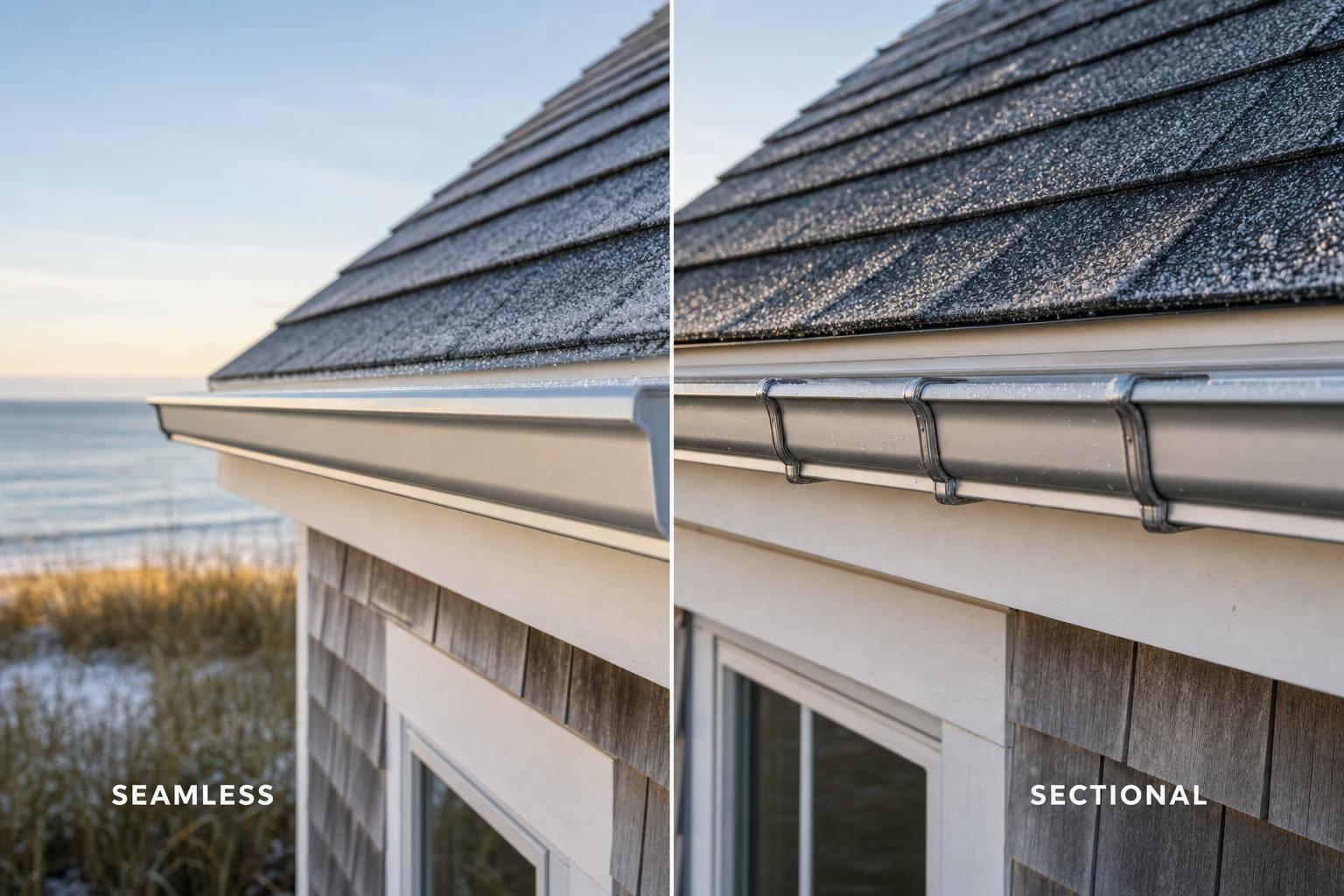
For most Rhode Island homes, sectional gutters cost less upfront, but one-piece gutters usually make more sense over time.
If you live in Rhode Island, your gutters have to deal with heavy rain, snow, ice, leaves, salt air, and freeze-thaw swings. That matters because gutters with more joints tend to leak sooner, need more resealing, and often wear out faster. In this comparison, you’ll see the main tradeoffs in price, leak risk, lifespan, repairs, DIY fit, and upkeep.
Here’s the short answer:
- One-piece gutters are often the better pick for a full-house replacement
- Sectional gutters can still work for small repairs, short runs, sheds, and tight budgets
- In Rhode Island, freeze-thaw stress hits joints first
- Aluminum often lasts 20 to 30 years
- Copper can last 50+ years
- Sectional systems often last 10 to 20 years
- Installed costs in the article range from $5 to $15 per linear foot vs. $3 to $8 per linear foot
- Sectional gutters may need resealing every 1 to 5 years
Which is the Better Gutter, Seamless Gutters or Sectional Gutters?
Regardless of which style you choose, regular gutter cleaning in Rhode Island is essential to prevent water damage from coastal storms and winter ice.
sbb-itb-634c8b2
Quick Comparison
| Type | Upfront Cost | Leak Risk | Lifespan | Upkeep | Best Fit |
|---|---|---|---|---|---|
| One-piece gutters | $5–$15/linear foot | Lower | 20–30 years for aluminum; 50+ years for copper | Lower | Main homes, long-term use, coastal areas |
| Sectional gutters | $3–$8/linear foot | Higher | 10–20 years | Higher | Repairs, short sections, garages, sheds |
Bottom line: if your goal is fewer leaks and less joint trouble in Rhode Island weather, one-piece gutters usually win. If your goal is the lowest starting cost or a small repair, sectional gutters may still be the right fit.
The full article below breaks down where each option fits and what Rhode Island weather does to both.
Rhode Island Climate and How It Affects Gutter Performance
Weather conditions that wear gutters down
Rhode Island weather is hard on gutters. Heavy rain, falling leaves, snow, and ice all put pressure on the system. In fall, gutters can clog fast. Then winter piles on more stress with snow and ice that weigh down the troughs and pull at the hangers.
When gutters overflow, water can end up around the foundation and increase the risk of basement moisture. Coastal homes deal with one more problem: salt air speeds up corrosion, especially in older metal gutters.
The first places this damage tends to show up are the seams and fasteners.
How freeze-thaw cycles stress gutter joints
This is where sectional gutters often run into trouble in Rhode Island. When temperatures drop below freezing and then warm up again, the gutter material expands and contracts a little each time. That repeated movement puts stress on the caulked joints that connect each section.
After enough cycles, the sealant can crack or pull apart. Once that happens, water slips into the opening, freezes, and forces the gap even wider. That freeze-thaw pattern is a big reason sectional gutters fail here, and it's a strong point in favor of seamless systems in Rhode Island. A single continuous run simply has fewer weak spots.
That joint stress sets up the main difference in the next side-by-side look.
Gutter materials commonly used on Rhode Island homes
Aluminum is the go-to pick for most Rhode Island home installs. It’s light, resists rust, and handles cold winters well without needing extra support. For coastal homes or houses that get heavy snow, heavy-gauge .032 aluminum does a better job carrying the load.
Copper is often used on historic homes and higher-end installs. It can last 50 years or more and doesn’t need paint, though the upfront price is much higher.
Vinyl is the low-cost option, but cold weather makes it weaker, which makes it a poor match for Rhode Island winters. Galvanized steel is tough, but near the coast it’s more likely to rust because salt air is always in the mix. For most homes, aluminum offers the best mix of performance, lifespan, and price.
For coastal areas, use stainless steel screws. They hold off corrosion longer than standard fasteners and help the gutter system last longer.
And once again, the weak spots usually show up first at the seams, which is where the system comparison begins.
Seamless vs. Sectional Gutters: Pros, Cons, and Where Each Fits
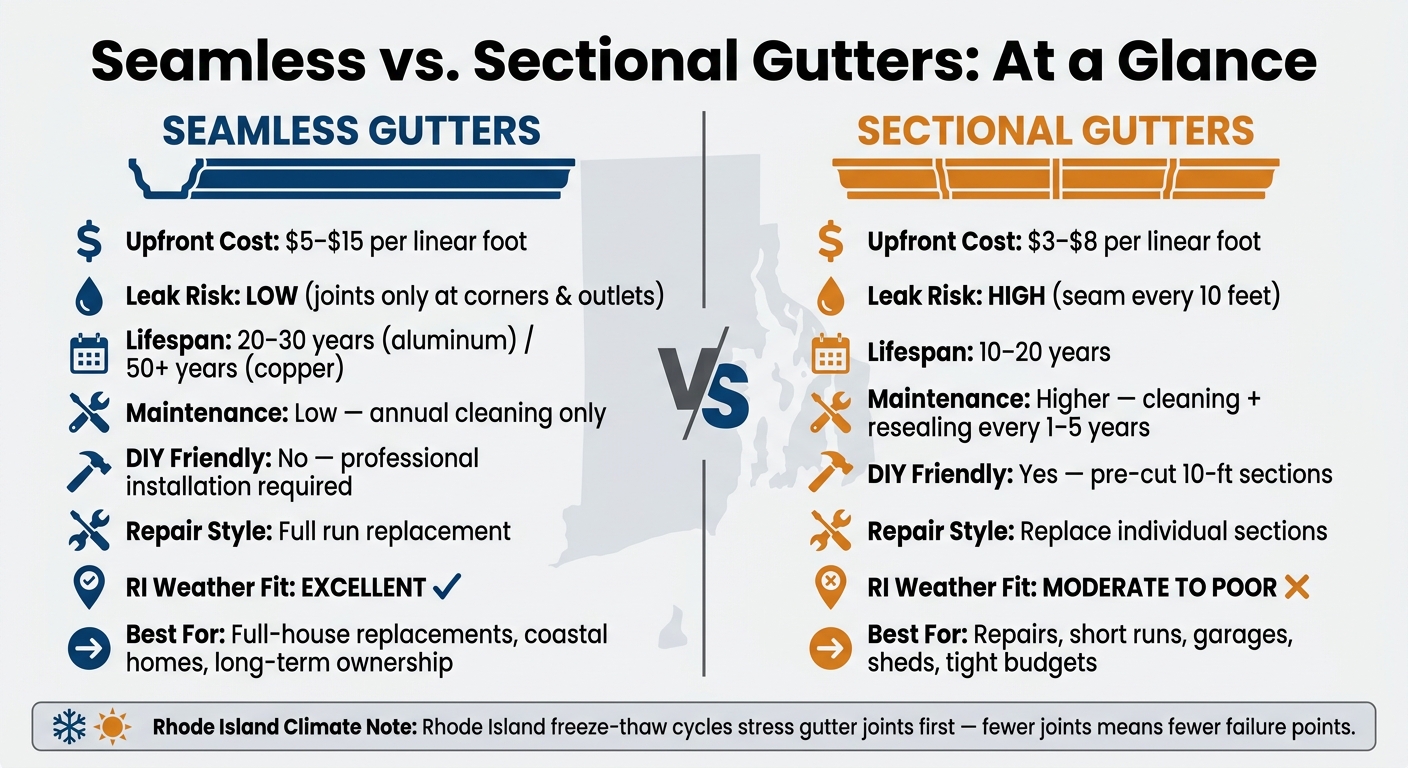
Seamless vs. Sectional Gutters: Cost, Lifespan & Performance Comparison
Once you factor in Rhode Island weather, the choice mostly comes down to joints, price, and upkeep.
Seamless gutters on Rhode Island homes
Seamless gutters are made on-site in one continuous run, with joints only at corners and outlets. That matters because fewer joints mean fewer spots where water can leak out.
Seamless aluminum usually lasts 20 to 30 years, while copper can last 50+ years. Professionally installed seamless aluminum usually costs $5 to $15 per linear foot. It also takes a trained crew and special equipment to handle a seamless gutter installation correctly.
The big upside is simple: lower leak risk and less resealing over time.
Sectional gutters and when they still make sense
Sectional gutters use pre-cut pieces connected with joints and sealant. They cost less at the start and are easier for small DIY projects. Aluminum or vinyl sectional gutters usually cost $3 to $8 per linear foot.
They can be a good fit for:
- A detached garage or shed where custom fabrication doesn't make sense
- A short run on an addition where matching existing sections is easier
- A localized repair after branch damage, where swapping one damaged section makes more sense than replacing the whole system
In cases like those, sectional gutters can do the job without spending more than you need to. The catch? You have to go in with your eyes open about the upkeep.
Leak risk, lifespan, and upkeep compared side by side
Here’s the side-by-side view that matters most when you’re looking at quotes.
| Feature | Seamless Gutters | Sectional Gutters |
|---|---|---|
| Installation | Professional only; on-site fabrication | DIY-friendly; pre-cut 10-ft sections |
| Upfront Cost | $5–$15 per linear foot | $3–$8 per linear foot |
| Leak Risk | Minimal (joints only at corners/outlets) | High (seam every 10 feet) |
| Lifespan | 20–30 years (aluminum); 50+ years (copper) | 10–20 years |
| Maintenance | Low; annual cleaning | Higher; cleaning + resealing every 1–5 years |
| DIY Suitability | Not applicable | Feasible for small projects |
| Repair Flexibility | Requires replacing entire runs | Can replace individual sections |
| RI Fit | Excellent | Moderate to poor |
Sectional systems also need more resealing and more frequent checks. So while the starting price is lower, that gap can shrink over time if repairs, resealing, and earlier replacement start piling up.
Next comes the practical part: which gutter type fits a full replacement, a small repair, or a budget-limited project.
Matching the Right Gutter Type to Your Rhode Island Home
Use the comparison above to pick what fits your home, not just the lowest quote. When you look at leaks, cost, and upkeep, the best option usually comes down to how you use the house and how long you plan to keep it.
When seamless gutters are usually the better investment
If you're replacing gutters on your main house and expect to stay for years, seamless gutters are usually the better investment. They tend to last longer, which can push back the next full replacement.
They also make more sense on homes with complex rooflines. More corners and turns usually mean more joints in a sectional system. With seamless gutters, on-site fabrication cuts down on those extra joints and lowers the number of leak points.
Coastal Rhode Island homes can also do well with seamless aluminum or copper. Salt air can speed up corrosion, so material choice matters more near the water.
And if your current sectional gutters have a history of joint leaks or freeze-thaw damage, that’s a pretty clear sign. Small repairs can seem cheap at first, but repeated fixes add up fast. If you’re dealing with steady clogs, leaks, or sagging, a full seamless replacement may cost less over time.
That’s why seamless is often the better fit for full-house replacements, while sectional tends to make more sense in narrower situations.
When sectional gutters can still be a reasonable choice
Sectional gutters can still be the right call in some cases. If the damage is limited to one area, a $100 to $500 repair may be the smarter move. That’s often the case when the rest of the gutter system is still in good shape.
Historic homes are another exception. Some older Rhode Island homes need half-round profiles or copper to match the original look, and sectional parts can be more practical for that kind of work.
Still, the long-term result depends on one simple thing: how much upkeep you’re willing to deal with.
Why maintenance matters after installation for either system
No gutter system is hands-off. Seamless gutters usually need less attention, but they still collect leaves, grit, and other debris. Sectional gutters need that same cleaning, plus periodic resealing at the joints. Over the years, that can mean more time and more money.
For both types, seasonal cleaning is the baseline. Gutter guards can cut down how often you need to clean, but they don’t get rid of maintenance altogether.
Seamless gutters usually need less resealing. Sectional gutters need more joint care.
Conclusion: The Clearer Choice for Most Rhode Island Homes
For most Rhode Island homes, seamless gutters hold up better over time. Freeze-thaw cycles and coastal exposure put real stress on gutter systems, and fewer joints means fewer places for that stress to show up as leaks.
Sectional gutters still make sense for repairs, short runs, or matching an existing system. For a full replacement, the extra joints add upkeep and failure points that compound over years.
The right call depends on your roof layout, your budget, and how much maintenance you want to take on. When you compare quotes, look at the full scope and long-term maintenance load, not just the install price.
Downspout Services installs seamless gutters across Rhode Island. Get a quote sized to your roof before you decide.
FAQs
How do I know if my gutters should be repaired or replaced?
Minor problems like a small leak, a crack, or a few sagging spots can often be fixed. A pro may reseal the seams, swap out broken hangers, or adjust the gutter pitch so water flows the way it should.
Replacement is usually the smarter long-term move when the damage shows up in many areas, leaks keep coming back, rust appears in several sections, the gutters are pulling away from the roofline, the system is old, or the fascia boards are starting to rot.
Are gutter guards worth adding in Rhode Island?
Yes, for many Rhode Island homeowners, gutter guards are worth adding. Premium picks like micro-mesh guards help keep out debris such as leaves, pine needles, and pollen, which means fewer clogs and less upkeep.
That gives your gutters a better shot at handling heavy rain and snowmelt, which matters in Rhode Island’s climate. Professionally installed guards usually cost about $10 to $25+ per linear foot.
What gutter material is best for coastal Rhode Island homes?
For coastal Rhode Island homes, heavy-gauge aluminum (0.032-inch) or copper is the best fit. In most cases, seamless aluminum is the go-to option because it’s affordable, resists rust, and holds up well through freeze-thaw cycles.
For homes right on the coast, copper is the premium pick. It stands up to salt-air corrosion and forms a protective patina over time. And with either material, a seamless design helps cut leak risk and supports long-term durability.
Related Blog Posts
Heading 1
Heading 2
Heading 3
Heading 4
Heading 5
Heading 6
Lorem ipsum dolor sit amet, consectetur adipiscing elit, sed do eiusmod tempor incididunt ut labore et dolore magna aliqua. Ut enim ad minim veniam, quis nostrud exercitation ullamco laboris nisi ut aliquip ex ea commodo consequat. Duis aute irure dolor in reprehenderit in voluptate velit esse cillum dolore eu fugiat nulla pariatur.
Block quote
Ordered list
- Item 1
- Item 2
- Item 3
Unordered list
- Item A
- Item B
- Item C
Bold text
Emphasis
Superscript
Subscript