Do Christmas Lights Increase Your Electric Bill?
See how wattage, runtime, and kWh rates affect holiday lighting costs—LEDs can cut use 80–90% vs incandescent.
Yes - Christmas lights add to your electric bill, but the cost is often lower than people expect.
Your total depends on three things: wattage, hours used, and your electric rate per kWh. In many cases, LED lights use 80% to 90% less electricity than incandescent bulbs, which can cut a full-season cost from about $17.28 to $2.16 for a 1,000-light roofline setup.
Here’s the short version:
- Small LED displays may cost well under $1 to a few dollars for the season
- Incandescent setups cost more because they use far more power
- Run time matters just as much as bulb type
- Inflatables, projectors, and lighted figures also add to the total
- Timers and shorter run times help keep costs down
- Circuit load and outdoor wiring safety matter for bigger displays
Your cost can be estimated with this formula:
(Total Watts × Hours per Day × Number of Days) ÷ 1,000 × Electric Rate = Seasonal Cost
A few sample numbers make the difference clear:
| Setup | Bulb Type | Seasonal Cost |
|---|---|---|
| Small tree, 300 lights | Incandescent | $5.18 |
| Small tree, 300 lights | LED | $0.65 |
| Roofline, 1,000 lights | Incandescent | $17.28 |
| Roofline, 1,000 lights | LED | $2.16 |
| Large yard, 3,000 lights | Incandescent | $51.84 |
| Large yard, 3,000 lights | LED | $6.48 |
These examples use 6 hours per night for 45 days at $0.16/kWh.
Bottom line: if your display uses LEDs, runs on a timer, and skips extra plug-in decor, your holiday lighting cost may stay low. If your setup uses incandescent strands and runs long hours, the bill climbs much faster.
The rest of the article breaks down the math, the cost gaps between bulb types, and the safety points that matter before you plug everything in.
How much do Christmas lights add to your electric bill?
sbb-itb-634c8b2
How Christmas Lights Affect Your Electric Bill
Your electric bill comes down to two things: how much power your display uses and how long it stays on. That’s it.
The Numbers That Matter: Watts, Hours, and Rate Per kWh
Utilities bill you for electricity in kWh. To figure that out, you need three inputs: wattage, hours, and your rate per kWh.
Wattage tells you how much power your lights use at a given moment. Hours tells you how long they run each night. Multiply watts by hours, divide by 1,000, and you get kWh, which is the unit power companies bill for.
Then there’s your electric rate. You’ll find it on your monthly utility bill as the rate per kWh. In the U.S., home electricity rates often fall between $0.11 and $0.20 per kWh.
Use this formula:
(Total Watts × Hours per Day × Number of Days) ÷ 1,000 × Electric Rate ($/kWh) = Total Seasonal Cost
So if your display has more strands, uses more watts, or stays on longer, your cost goes up. Simple math, but it adds up fast.
Typical U.S. Cost Ranges for Seasonal Lighting
To get a number that matches your home, use the exact kWh rate listed on your bill. That one detail can shift the total more than people expect.
Bulb type matters too. LED holiday lights use 80% to 90% less electricity than traditional incandescent strings. That’s a big gap, and it can show up on your bill over the course of the season.
In plain terms, your total is shaped by two main levers: how many strands you run and how many hours they stay on. A timer helps control both. Next, we’ll put the formula to work with common LED and incandescent setups.
How Much Common Christmas Light Setups Cost to Run
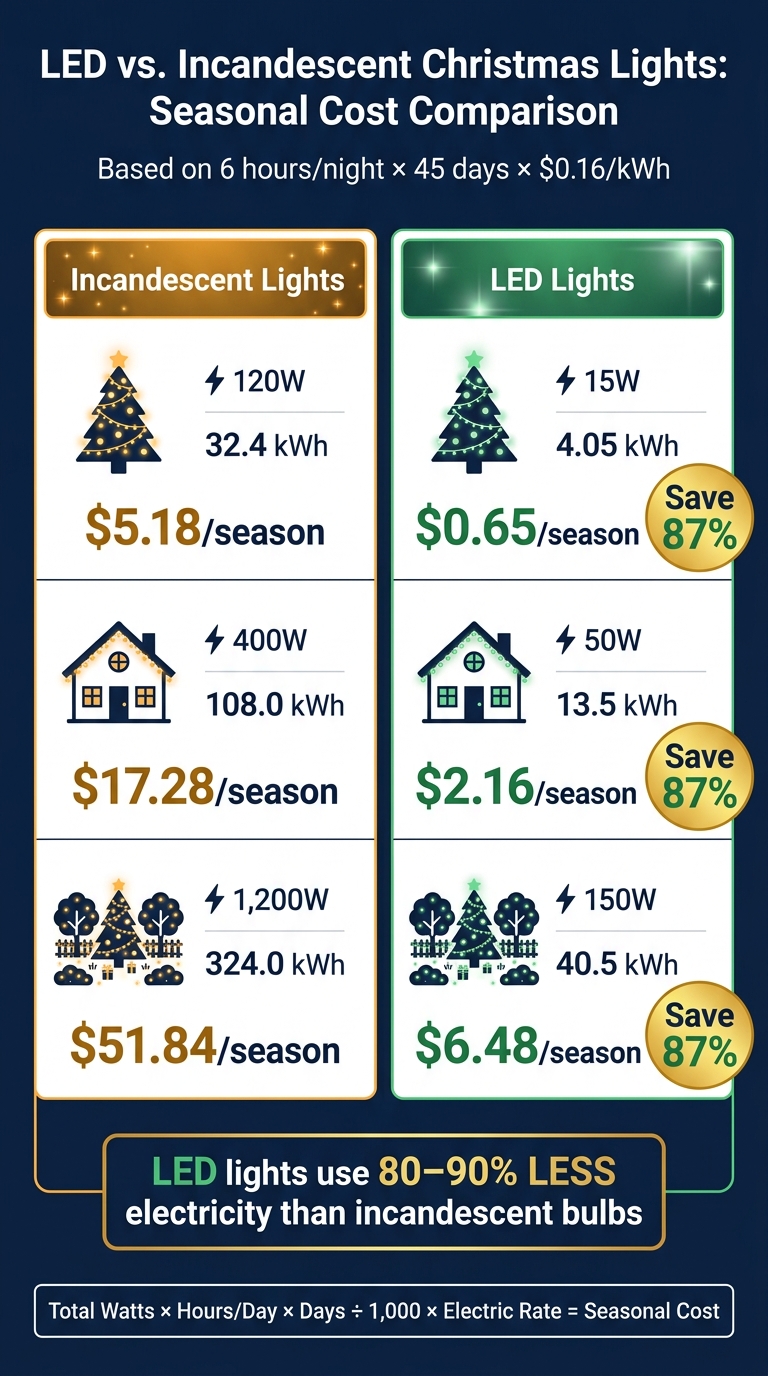
LED vs. Incandescent Christmas Lights: Seasonal Cost Comparison
Examples make this a lot easier to picture. These estimates assume 6 hours per night for 45 days at $0.16/kWh. Once you plug those numbers in, the cost difference between setups gets pretty clear.
Sample Cost Estimates for LED and Incandescent Strands
A standard 100-count incandescent mini-light strand uses about 40 watts. A similar 100-count LED strand uses just 5 to 10 watts - about 80% to 90% less electricity.
On one strand, that may not sound like a huge gap. But over a full season, and across multiple strands, it adds up fast.
Here’s a simple example. Three incandescent strands on a small tree use about 32.4 kWh over 45 nights, which comes to about $5.18. Switch to LED strands, and that same tree costs about $0.65 to $1.30 for the season.
Same look. Very different power use.
Why Display Size Changes Your Total Cost More Than You Might Think
A small porch setup usually has a minor effect on your bill. The story changes once you start outlining the roof, wrapping trees, and adding decorations across the yard. At that point, the wattage starts stacking up.
A big yard display can use about 10 times more electricity than a small tree.
| Display Type | Bulb Type | Total Watts | Seasonal kWh (270 hours) | Est. Seasonal Cost |
|---|---|---|---|---|
| Small Tree (300 lights) | Incandescent | 120W | 32.4 kWh | $5.18 |
| Small Tree (300 lights) | LED | 15W | 4.05 kWh | $0.65 |
| Roofline (1,000 lights) | Incandescent | 400W | 108.0 kWh | $17.28 |
| Roofline (1,000 lights) | LED | 50W | 13.5 kWh | $2.16 |
| Large Yard (3,000 lights) | Incandescent | 1,200W | 324.0 kWh | $51.84 |
| Large Yard (3,000 lights) | LED | 150W | 40.5 kWh | $6.48 |
Estimates based on 6 hours per night for 45 days at $0.16/kWh.
The roofline example is where many homeowners get caught off guard. A 1,000-light incandescent setup can add more than $17 to your seasonal electric bill by itself. The LED version of that same setup costs a little over $2 for the full season.
And if you pile on more powered decorations, that gap gets even bigger.
LED vs. Incandescent Lights and Other Decorations That Add to the Bill
Light strands are only part of the load.
LEDs save the most on power, but run time and the size of your display still shape the final cost.
Why LED Lights Cost Much Less to Run
Incandescent bulbs turn most of their electricity into heat instead of light. LEDs work differently. They use more of that electricity for light and less for heat, which is why LED holiday lights use 80% to 90% less electricity than old incandescent strings.
That gap adds up fast when you hang multiple strands. One string may not look like much on paper, but a whole roofline, a few bushes, and a tree can make the difference pretty obvious.
Inflatables, Projectors, and Lighted Figures Also Use Power
Holiday lights aren't the only thing pulling electricity. Inflatables, projectors, and lighted yard figures also use power, and they can push your bill higher .
The more plug-in decorations you add, the more electricity you use. A timer helps keep that in check by shutting everything off after a set number of hours.
How to Estimate Your Own Costs and Plan a Safer Display
Once you know what drives the cost, you can estimate your total pretty fast.
A Step-by-Step Cost Formula for Your Property
Use your wattage, runtime, and electric rate to estimate your seasonal cost.
Use this formula:
| Step | What to Do | Example |
|---|---|---|
| 1. Find total watts | Add wattage from all strands and decorations | 10 LED strands × 5W = 50W |
| 2. Convert to kW | Divide total watts by 1,000 | 50 ÷ 1,000 = 0.05 kW |
| 3. Calculate kWh | Multiply kW × hours per night × days | 0.05 × 6 hrs × 30 days = 9 kWh |
| 4. Find your cost | Multiply kWh × your electric rate | 9 × $0.16 = $1.44 for the season |
Just swap in your own numbers for wattage, hours, days, and electric rate.
Cost is only one part of the picture. Circuit load matters too. Keep your total load under 80% of circuit capacity to help cut down on breaker trips and overheating.
When Professional Holiday Light Installation Makes Sense
If your estimate shows a heavier load, the next thing to look at is layout and wiring.
Big rooflines, trees, and yard decorations need more careful circuit planning. Higher-wattage items should be spread across separate circuits. Outdoor-rated connections matter. Cord routing matters too, especially in wet winter conditions.
Downspout Services' holiday light installation can help plan the display around your home's circuit capacity, spread the load more evenly, and make outdoor routing safer.
Conclusion: Christmas Lighting Costs Are Easier to Control Than You Think
Yes, Christmas lights can increase your electric bill. But the total depends on your wattage, runtime, and decoration load.
LEDs and timers help keep seasonal lighting costs low. Incandescent strands and powered decorations cost more and need closer planning. Downspout Services sizes each holiday light display around the client's circuit capacity so wattage stays predictable before installation day. Estimate your cost before you hang the lights, and you can skip surprise charges on your bill.
FAQs
How do I find the wattage of my Christmas lights?
Check the manufacturer's instructions on the packaging. In most cases, they list the power use for each light or the total wattage for the entire string.
If the box doesn't show that info, check the tags attached to the light cord for the electrical specs. Also make sure the lights are UL-listed for safety.
Do timers really lower holiday lighting costs?
Yes - timers can cut holiday lighting costs by controlling when the lights are on instead of letting them run longer than needed.
To trim electricity use even more, pair timers with LED lights. They use about 80% to 90% less electricity than incandescent bulbs. It also helps to calculate the total wattage before you string the lights up, which can help you avoid overloading and wasting power.
Can Christmas lights overload an outdoor circuit?
Yes - Christmas lights can overload an outdoor circuit if you plug in too many strands or decorations.
To help prevent this, plan the total wattage ahead of time, use outdoor-rated, UL-listed equipment, avoid plugging too many items into one outlet, and make sure your lights are connected to GFCI-protected outdoor outlets.
If your breaker trips often, that’s a strong sign the circuit may be overloaded. In that case, you may need to spread the load across other circuits or have the electrical panel upgraded.
Related Blog Posts
Heading 1
Heading 2
Heading 3
Heading 4
Heading 5
Heading 6
Lorem ipsum dolor sit amet, consectetur adipiscing elit, sed do eiusmod tempor incididunt ut labore et dolore magna aliqua. Ut enim ad minim veniam, quis nostrud exercitation ullamco laboris nisi ut aliquip ex ea commodo consequat. Duis aute irure dolor in reprehenderit in voluptate velit esse cillum dolore eu fugiat nulla pariatur.
Block quote
Ordered list
- Item 1
- Item 2
- Item 3
Unordered list
- Item A
- Item B
- Item C
Bold text
Emphasis
Superscript
Subscript