What Extension Cords Are Safe for Outdoor Christmas Lights?
Use outdoor-rated UL/ETL cords (SJTW/SJTOW), size by gauge and wattage, plug into GFCI outlets, and keep connections dry.
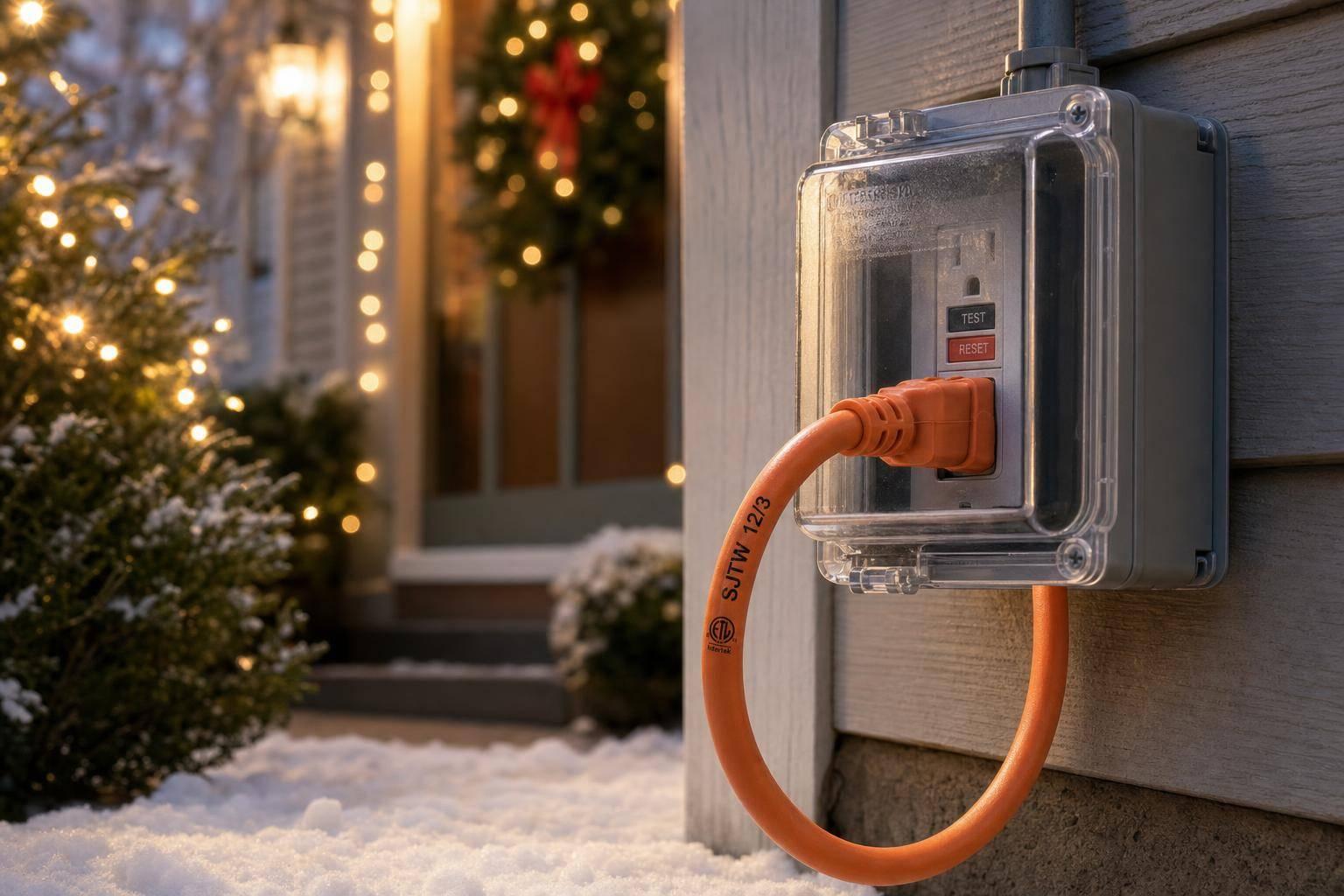
The safe pick is simple: use an outdoor-rated extension cord, match the gauge to the load and distance, and plug it into a GFCI-protected outlet.
For outdoor Christmas lights, you should look for a cord marked UL or ETL, labeled for outdoor use and wet locations, and sized for both the total wattage and the length of the run. For example, 240 watts ÷ 120 volts = 2 amps, which helps you check whether the cord can handle the load.
Before you plug anything in, check these points:
- Outdoor rating: Look for markings such as SJTW or SJTOW
- Safety listing: Use cords with UL or ETL labels
- Load size: Add up total watts and divide by 120V
- Cord length: Keep runs as short as possible
- Cord thickness: Use 12- or 14-gauge cords for longer or heavier runs
- Outlet safety: Plug into a GFCI outlet
- Moisture control: Keep plugs off the ground and out of puddles, snow, and meltwater
- Storage: Dry cords fully, coil them loosely, and store them indoors after the season
New England winter weather can be rough on cords, especially in cold snaps, wet snow, and freeze-thaw conditions. That is why your cord’s jacket, outlet cover, and plug connections matter just as much as the lights.
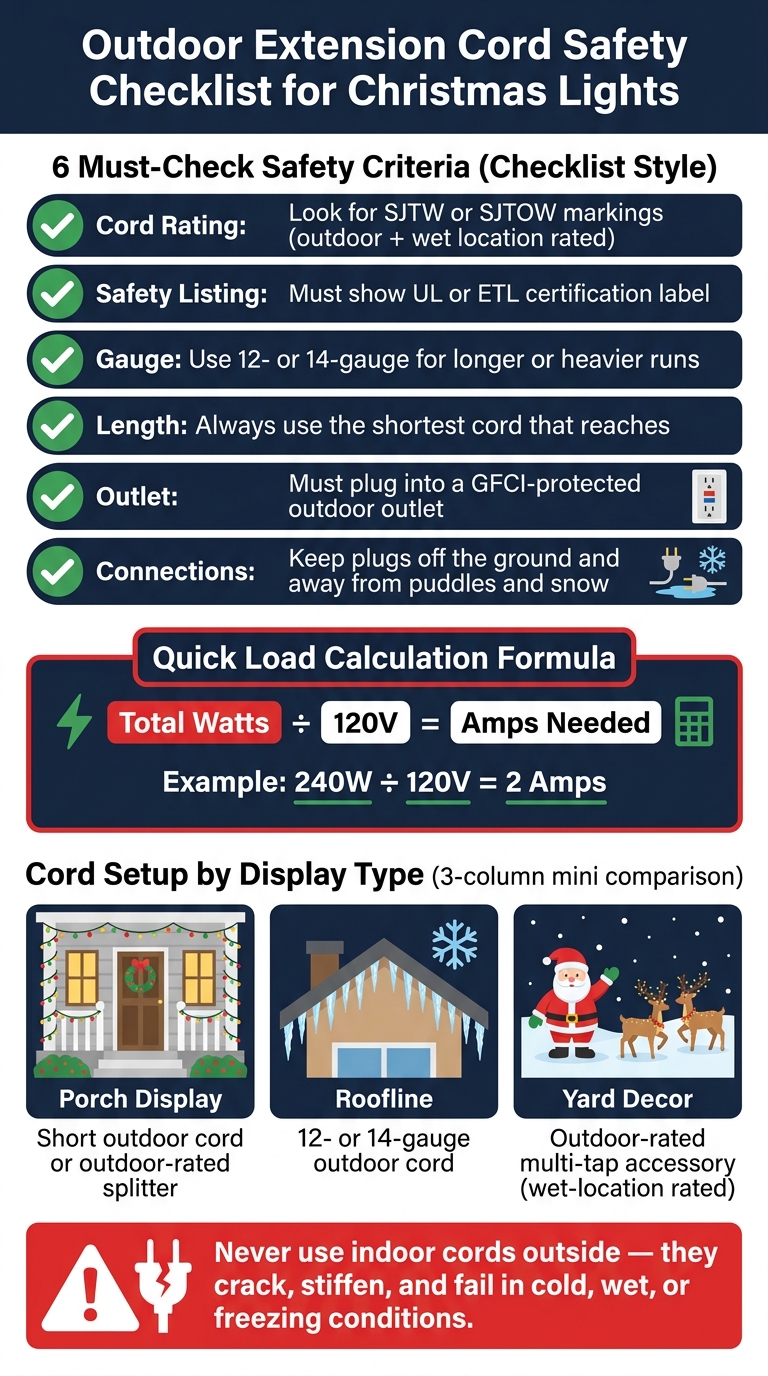
Outdoor Extension Cord Safety Checklist for Christmas Lights
How To Safely Run Extension Cords For Christmas Lights on Your House(Tips You Need To Know)
sbb-itb-634c8b2
Quick Comparison
| Check | What to look for | Why it matters |
|---|---|---|
| Cord rating | Outdoor use and wet location markings | Indoor cords can crack, stiffen, or fail outside |
| Listing | UL or ETL | Shows the cord meets tested safety standards |
| Gauge | 12- or 14-gauge for longer/heavier runs | Thicker cords handle distance and load better |
| Length | Shortest cord that reaches | Longer cords add resistance |
| Outlet | GFCI-protected outdoor outlet | Cuts power during a fault |
| Connections | Off the ground, under an in-use cover | Helps limit water exposure |
This article breaks down how to read the cord label, size the cord for your display, and keep every outdoor connection safer through winter.
Check the cord rating before you plug anything in
Check the label on the cord before you plug in the lights. You want to see a UL or ETL listing, plus wording that shows the cord is approved for outdoor use and wet locations. If either marking is missing, don't use that cord outside.
Once the cord clears that first check, move on to the gauge and the length.
What outdoor and wet-location markings on a cord mean
Look for markings like SJTW or SJTOW. Both mean the cord is rated for outdoor use, and SJTOW also means it has oil resistance.
That outdoor rating isn't just label jargon. These cords are made to handle UV exposure, sun, and snow. Indoor cords aren't. They don't have the weather-ready jackets or sealed connections needed for wind-driven rain or snow.
That matters a lot in New England, where a cold snap can turn a cheap cord jacket stiff in no time.
Why indoor cords fail faster in New England cold snaps
Indoor cords tend to stiffen in freezing weather, and New England cold snaps push that problem harder. When temperatures bounce up and down and moisture freezes and thaws, lower-grade plastics can turn brittle and split.
Coastal New England adds another problem: salt-laden spray and heavy moisture. That mix can corrode electrical parts that aren't weatherproof.
Next, match the cord gauge to the total amps your lights draw.
Match cord gauge and length to your Christmas light load
The safest outdoor extension cord for Christmas lights is one that matches both the power draw and the distance. Here’s the simple way to size it: add the wattage of everything plugged into that cord, divide the total by 120 volts, and compare that number to the cord’s printed amp rating. Stay within that limit.
Distance matters too. A longer cord isn’t just more cord. It also adds more resistance, which can make the cord work harder. That’s why you shouldn’t use extra length unless you need it.
How to use light labels to calculate total amps
Check the label on each light set and decoration connected to the same cord. Add the wattage together, then divide by 120 volts to get the total amps.
For example, if everything on one cord adds up to 240 watts, that load equals 2 amps. Then compare that result with the amp rating printed on the cord’s label.
Use a heavier-gauge cord for longer runs or larger displays
If the run is longer or the display pulls more power, step up to a thicker cord. In plain English, heavier-gauge cords are built to handle more demanding setups over more distance.
Use the shortest cord that reaches. If you need a longer run, use a heavier gauge because resistance goes up as cord length increases.
Once the cord size is right, the outlet matters next: use GFCI protection and keep every connection weather-safe.
Use GFCI-protected outlets and keep connections weather-safe
Once you’ve picked the right cord size, plug it into a GFCI-protected outdoor outlet. The cord’s rating and gauge matter, but they’re only part of the safety picture. The outlet and every connection point need protection too.
A GFCI, or Ground-Fault Circuit Interrupter, shuts off power when it detects a fault. That extra protection matters when cords, snow, meltwater, and wet decorations are all part of the setup. Even a safe cord can become a problem if the outlet, cover, or plug connection is left exposed.
Test the outlet before you start decorating. If an outdoor outlet doesn’t trip and reset the way it should, repair or replace it.
How to test your GFCI and inspect the outlet cover
Test the GFCI before the season starts so you know it trips and resets the way it should. Then check the outlet cover too. Outdoor outlets need an in-use cover that can close around the plug.
In New England, freeze-thaw cycles can force moisture into tiny gaps, so replace any cover that’s cracked, loose, or missing before you decorate.
Keep plug connections off the ground and out of pooling water
Keep every plug connection off the ground and away from meltwater, puddles, and snowbanks. Route cords so the connection points stay dry instead of sitting in low spots where water can collect.
With the outlet protected, the next step is picking the cord layout that fits your porch, roofline, or yard display.
Pick the right cord setup for your display and store it safely
Once the outlet is protected, the next step is matching the cord setup to the display. That part matters more than people think. Long, thin cords tend to run warmer, and in New England cold snaps, they can turn brittle sooner.
Cord setups for porch displays, rooflines, and yard decorations
A small porch display - like a wreath and a few strands of lights along the railing - usually works best with a short outdoor-rated cord or an outdoor-rated splitter. A shorter cord keeps things neater and cuts down on tripping risks near the front door.
Low, compact displays don’t need the same setup as a long roofline run. Rooflines call for heavier outdoor cords because the runs are longer and more exposed to the weather. A long 16-gauge cord is a bad fit here because voltage drop goes up as distance increases. Use 12-gauge or 14-gauge outdoor cords instead.
For yard decorations spread across the lawn, outdoor-rated multi-tap accessories labeled for wet-location use make it easier to power several items from one connection point. That helps you avoid daisy-chaining light-duty cords together. Stick with outdoor-rated accessories marked for wet locations, and keep all connection points off the ground.
| Display Type | Recommended Cord Setup | Key Safety Feature |
|---|---|---|
| Porch | Short outdoor cord / outdoor-rated splitter | Reduces tripping hazards and clutter |
| Roofline | 12- or 14-gauge outdoor cord | Handles longer runs and cold-snap exposure |
| Yard Decor | Outdoor-rated multi-tap accessory | Centralizes connections and keeps them weather-safe |
| Full-house displays | Multiple heavy-gauge runs to GFCI outlets | Prevents circuit overloading and voltage drop |
For larger displays, multiple shorter, heavier-gauge cords are usually a better call than one extra-long light-duty cord. They move current more efficiently, stay cooler under load, and hold up better through ice, wind, and freeze-thaw cycles.
When the season ends, don’t just toss the cords in a bin. Let them dry first, unplug them, coil them loosely, and store them indoors in a dry place until next year.
Conclusion: choosing the safest outdoor extension cord for Christmas lights
Match the cord to the size of the display and the length of the run, then store it dry after the season. A cord that’s properly sized, rated for outdoor use, and kept indoors between seasons will last longer and work safely through New England winters.
If the installation is complex - long roofline runs, a multi-zone yard display, or a full-house frontage - Downspout Services handles holiday light installation using outdoor-rated, cold-flexible cords and GFCI-protected circuits built for Rhode Island's winter conditions.
FAQs
Can I use a 16-gauge cord outside?
No. A 16-gauge cord is usually not a good pick for outdoor Christmas lights.
In New England, freezing weather can make thin, low-cost cord insulation turn stiff and crack. That can create a safety risk fast. Use a heavy-duty cord rated for wet locations and plug it into a GFCI-protected outlet.
How many light strands can one cord handle?
It depends on the total wattage of the light strands compared with the extension cord’s maximum rated capacity. Check the manufacturer’s tag on each strand, then make sure the combined wattage stays under the cord’s rating.
Be careful with daisy-chaining. Hooking up too many strands can overload the cord, and that’s a serious fire risk. It’s smarter to use heavy-gauge, outdoor-rated cords, especially during New England cold snaps, when thinner insulation can get stiff and crack.
Do I need a cover for outdoor plug connections?
Yes. A cover helps keep outdoor plug connections dry and secure.
In New England, moisture and ice buildup can create safety hazards. A protective cover helps block water from getting into the connection, which can lead to short circuits or damage your lighting system during winter.