How Much Do Gutter Guards Cost in Rhode Island?
Estimate gutter guard pricing based on gutter length, repairs, roof height, debris, and downspout work for Rhode Island homes.

Your gutter guard quote in Rhode Island depends more on your home and gutter condition than on a flat per-foot number.
If you want a close estimate, focus on the big cost drivers first: total gutter length, gutter repairs or cleaning, roof height and pitch, access around the home, tree debris, and downspout work. For many homes, that means checking 150 to 200 linear feet of gutters, plus any added labor from a two-story home, steep roof, or clogged and sagging sections.
Here’s the short answer:
- More gutter footage = higher base cost
- Cleaning, leaks, sagging, or rust add prep cost
- Two-story and three-story homes often cost more in labor
- Pine needles, seed pods, and shingle grit may require micro-mesh
- Downspout cleaning or replacement can add to the total
- Photos, footage, and roof details help you get a closer quote
A few Rhode Island numbers stand out:
- Homes often have 150–200 linear feet of gutters
- Gutter cleaning may cost about $80 per visit
- A two-story home can add 20%–30% to base labor
- A three-story home can add 40%–60%
- Downspout replacement may run $200–$700
- Downspout cleaning may run $100–$300
- 3x4-inch downspouts can move about 40% more water than smaller standard sizes
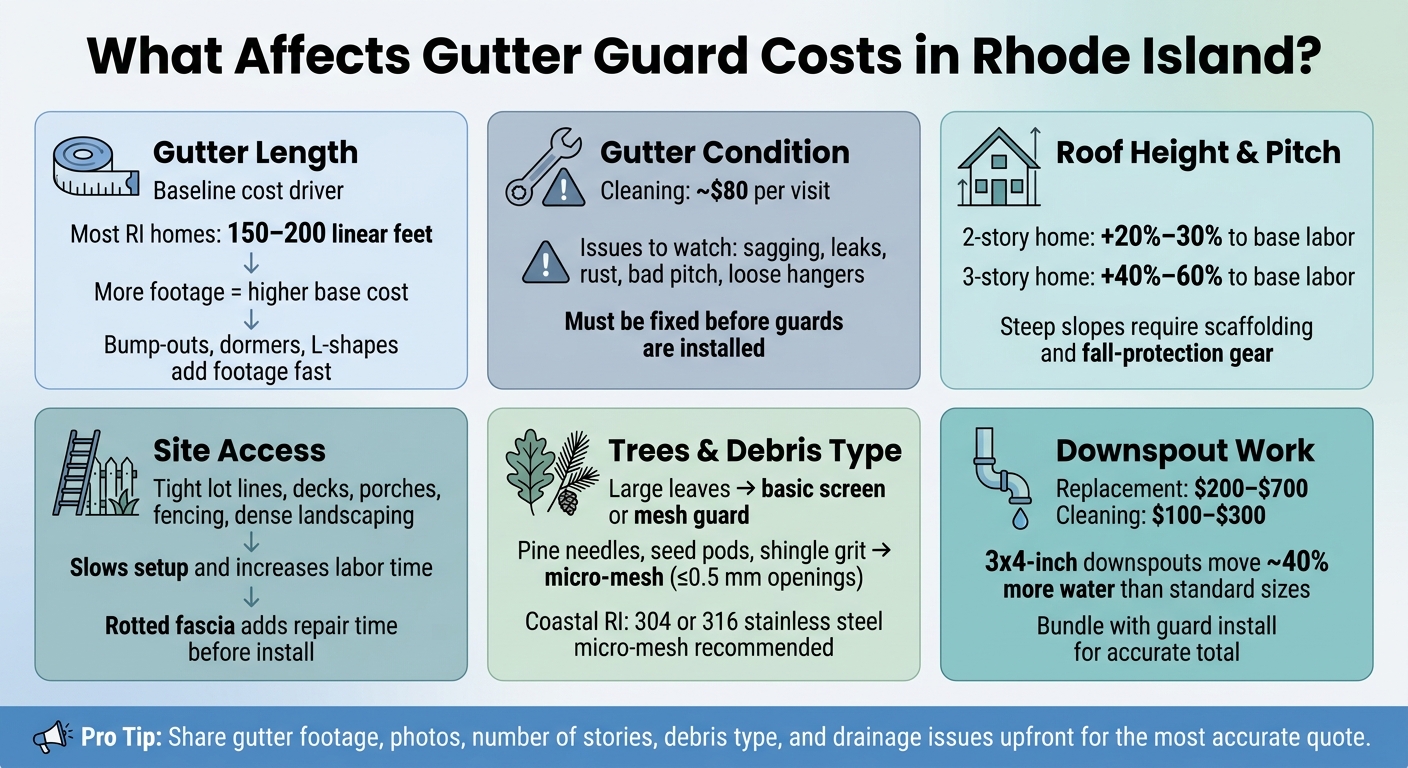
Gutter Guard Cost Drivers in Rhode Island: What Affects Your Quote
The Honest Truth: New Gutters & Gutter Guards: My Total Cost in 2026
sbb-itb-634c8b2
Quick Comparison
| Cost driver | What it affects | What usually pushes price up |
|---|---|---|
| Gutter length | Base install cost | More than 200 linear feet, bump-outs, dormers, L-shapes |
| Gutter condition | Prep work before install | Sagging, leaks, rust, bad pitch, loose hangers |
| Roof height and pitch | Labor and safety setup | Two or three stories, steep slopes |
| Access | Setup time and labor | Tight lot lines, decks, porches, fences, thick landscaping |
| Trees and debris | Guard type needed | Pine needles, seed pods, shingle grit, heavy leaf fall |
| Downspouts | Total drainage work | Clogs, disconnections, pooling near foundation |
If you’re pricing gutter guards, your best first step is to look past flat rate claims, compare gutter guards vs. regular cleaning, and check the parts of the job that shape the final quote.
Start With Linear Footage Because It Sets the Baseline Cost
Start with the total gutter length. That number drives the base cost of every quote. Measure the guttered roof edges first, because everything else comes from that total.
Most Rhode Island homes have about 150 to 200 linear feet of gutters, and larger or more complex roofs usually have longer runs.
How to Estimate Gutter Length Without Getting on the Roof
You can estimate gutter length from the ground with a tape measure or even a piece of string. Measure the perimeter where gutters are installed, but skip the gable ends - the triangular roof peaks that don’t have gutters. Add everything up, then add 10% for waste, end caps, and corner cuts.
If your gutters have been cleaned or replaced before, look at the old invoice or any house plans you still have. Those records can give you a solid starting point and save you from guessing.
Roof shape can add footage fast. Bump-outs, dormers, valleys, and L-shaped layouts create more guttered edges than a plain rectangle, even if the home doesn’t look that large at first glance. That’s common with older Rhode Island homes.
How Home Layout Changes the Total Installed Cost
Home layout changes both the footage and the labor. A single-story ranch often needs less gutter length. A two-story Colonial often needs more, plus extra fitting and labor, which pushes the installed cost higher.
Once you know the footage, the next thing that affects the quote is whether the gutters need cleaning or repair before guards are installed.
Check the Condition of Your Gutters Before Pricing the Guards
If your gutters sag, leak, or don’t drain the way they should, deal with that first. Clean them, repair them, or replace the bad sections before any guards go on. Interior stains, foundation leaks, fascia rot, or roof damage usually point to a gutter issue that needs attention first.
How Cleaning, Minor Repairs, or Partial Replacement Change the Quote
In Rhode Island, pro gutter cleaning is often priced on its own and usually costs about $80 per visit. That cleaning step does more than clear out leaves and gunk. It can also expose rust, pinhole leaks, or other damage that debris had been hiding.
During that check, installers look for loose hangers, split seams, improper pitch, and sagging runs. Downspout Services runs that same diagnostic pass on Rhode Island homes before any guard installation goes on the calendar. If water sits in the gutter instead of flowing, the slope needs to be fixed before guards go in. Leaky seams need sealing, and rusted or badly worn sections may need to be swapped out. A guard won't save a gutter that's already failing.
That prep work can change the quote before labor items like access or roof shape even enter the picture.
Why Rhode Island Weather Can Add to Prep Work
Rhode Island weather can be rough on gutters. Freeze-thaw cycles can loosen hangers and crack seams, and coastal moss may mean the roof or gutters need cleaning before installation . If the current gutters are close to the end of their lifespan, replacing them first usually makes more sense than putting guards on top of a worn-out system.
Once the gutters are in good shape, labor cost usually comes down to roof pitch, access, nearby trees, and the kind of debris the system has to handle.
Labor Factors That Change Your Quote: Pitch, Access, Trees, and Debris
After gutter repairs, the next price shifts usually come from job-site conditions. Two homes can have the same linear footage and still get very different quotes if one is much harder to work on safely.
How Steep Roofs, Multiple Stories, and Site Obstacles Affect Labor Cost
Pitch and height have a big effect on labor cost. A two-story home usually adds 20–30% to the base labor rate, while a three-story home can push that premium to 40–60%. The reason is pretty simple: crews often need scaffolding, roof anchors, and fall-protection gear to do the job safely.
Older Rhode Island homes add another layer of work. Many have dormers, hips, and valleys, and each of those transition points calls for more custom cutting and fitting than a long, straight roofline.
Access can also change the quote in a hurry. Tight lot lines, porches, decks, fencing, and dense landscaping can make ladder placement harder and slow down setup. It’s the kind of thing homeowners don’t always think about, but installers do.
Rotted fascia is another labor issue. Since guards fasten near it, any damaged wood can add repair time before installation even begins. In Rhode Island’s coastal climate, moisture often leads to rot that crews need to deal with first.
After pitch and access, tree cover and debris type usually become the next big pricing factors.
How Tree Coverage and Debris Type Affect Guard Choice and Price
Tree cover helps shape the guard choice. Large deciduous leaves from oaks and maples can often be handled with a basic screen or mesh guard. But pine needles, maple seed pods, and shingle grit are a different story. Those usually call for micro-mesh with openings around 0.5 mm.
In coastal Rhode Island, installers often suggest 304 or 316 grade stainless steel micro-mesh because it holds up better against salt spray.
Some guard types just don’t do well with fine debris. Foam and brush inserts are a poor fit because they can trap small material and break down fast, especially in a climate with heavy seasonal leaf fall and moisture. Reverse-curve systems also need exact pitch alignment to work the way they should. If water shoots past the gutter during heavy rain, the system has missed the mark.
If the downspouts need work too, it usually makes sense to price that at the same time instead of treating it like a separate visit.
Factor In Downspout Work and Prepare for a More Accurate Quote
When to Price Downspout Cleaning, Repair, or Replacement Together
Once you've matched the guard type to the debris load, the next step is pricing the downspouts that move water away from the house.
Downspouts shape the final drainage quote too. If they're clogged, sagging, or disconnected, it's smart to include cleaning or repair in the same quote.
A guard can't fix a drainage system that's already failing.
If water is pooling near the foundation or the basement stays damp, include downspout work in the same scope. In Rhode Island, downspout replacement usually costs $200–$700, while cleaning often lands between $100–$300. Bundling that work gives you a more accurate total for the job.
If you're moving up to 6-inch gutters to deal with heavier rainfall, price oversized 3x4-inch aluminum downspouts at the same time. They offer about 40% more drainage capacity than standard residential sizes.
To get a solid quote, gather the job details before you ask for pricing.
What to Send for a More Accurate Quote
The more detail you send at the start, the closer the estimate will be to the final number. Before you reach out, pull together:
- Estimated gutter footage
- Photos of each side of the home, including close-ups of any visible damage
- Number of stories and whether the roof has a steep pitch, dormers, or valleys
- Any visible gutter or downspout damage - sagging, leaks, or pulling away from the house
- Nearby trees and debris type
- Known drainage issues - basement dampness, pooling near the foundation, or slow-draining downspouts
Sending this information upfront helps cut down on estimate surprises.
FAQs
Can I install gutter guards on old gutters?
Yes - if the existing gutters are still in good shape.
Before installation, a professional should inspect the system for:
- sagging
- cracks
- loose fasteners
- fascia boards that are still secure
If the gutters are damaged, they may need to be repaired or replaced first. That way, the guards can be installed the right way and have the support they need.
What type of guard is best for pine needles?
Micro-mesh gutter guards are the top pick for homes surrounded by trees. Their fine screens block small debris like pine needles, pollen, and seeds.
At the same time, they let water flow smoothly, even during heavy rain.
Should I replace downspouts at the same time?
Yes. It’s smart to coordinate downspout work with gutter guard installation.
Here’s why: gutter guards sit on top of your current gutters, so the entire drainage system needs to be in good shape first. If the gutters or downspouts already have problems, guards won’t fix them. They can just hide the issue for a while.
Before installation, fix any:
- debris buildup
- clogs
- leaks
- slope problems
Handling downspout repairs or replacement at the same time also helps water move the way it should. That can help prevent future overflows.