What PSI Should You Use to Pressure Wash a House?
Most homes clean safely at 500–2,000 PSI; use soft washing under 500 PSI for delicate siding, 25°–40° tips, and keep the wand 12–24 in away.
Most houses should be washed at 500 to 2,000 PSI, and many can be cleaned more safely at under 500 PSI with soft washing vs pressure washing techniques. The right setting depends on your siding: vinyl and fiber-cement usually fit around 1,200–1,600 PSI, wood and stucco around 500–1,500 PSI, and brick or masonry around 500–2,000 PSI. The safest approach is simple: use the lowest pressure that cleans the surface, keep the wand 12 to 24 inches away, use a 25° or 40° tip, and spray downward.
Here’s the short version:
- Vinyl: often 1,200–1,600 PSI, but many makers prefer soft washing under 500 PSI
- Fiber-cement: usually 1,200–1,600 PSI
- Wood: usually 500–1,500 PSI
- Stucco: keep it low pressure, often near the bottom of the range
- Brick/masonry: usually 500–2,000 PSI
- Best nozzle for siding: 25° or 40°
- Safe working distance: 12 to 24 inches
- Big risk: spraying upward can force water behind siding
How to Pressure Wash Your Home, Fence, or Driveway Without Damaging Anything
sbb-itb-634c8b2
Quick Comparison
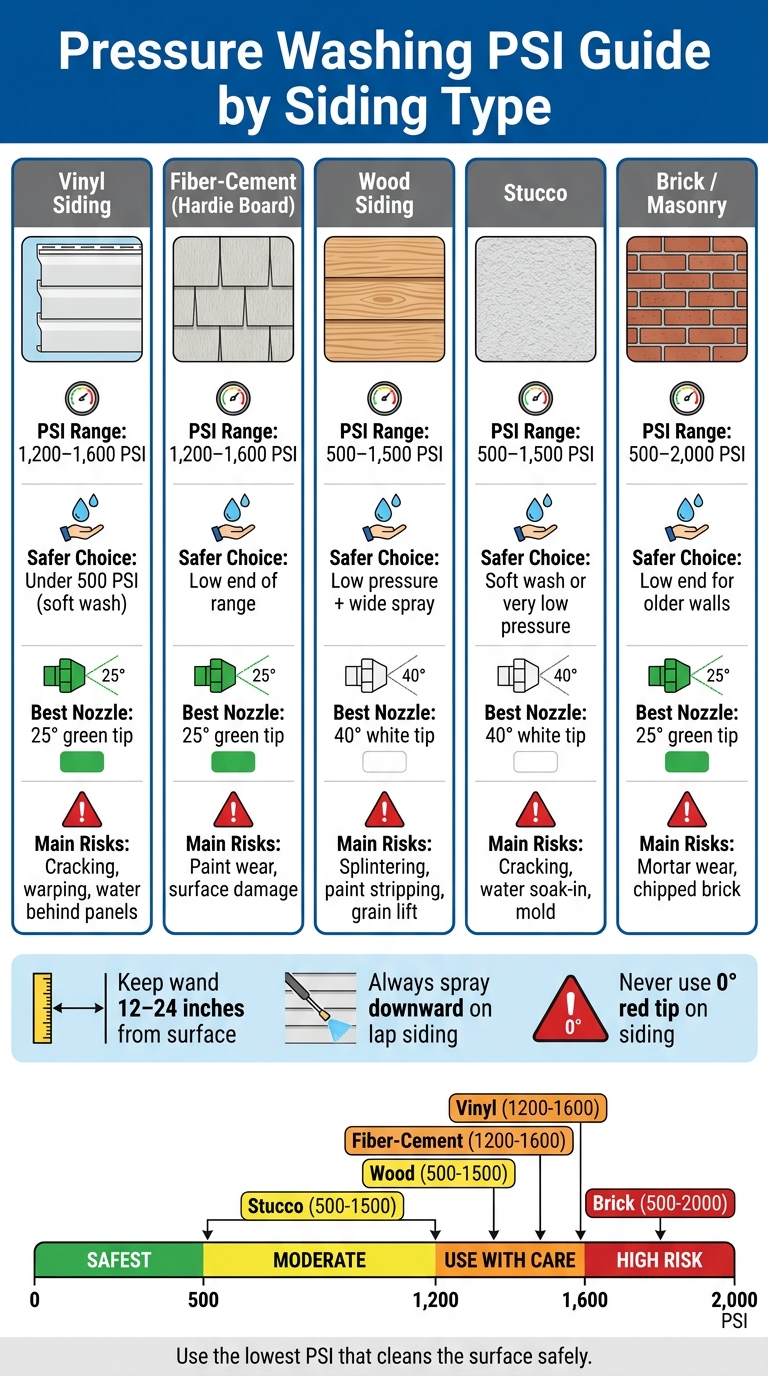
Pressure Washing PSI Guide by Siding Type
| Surface | Common PSI Range | Safer Choice | Main Risk |
|---|---|---|---|
| Vinyl | 1,200–1,600 | soft wash vs pressure wash methods under 500 PSI | Cracking, warping, water behind panels |
| Fiber-cement | 1,200–1,600 | Low end of range | Paint wear, surface damage |
| Wood | 500–1,500 | Low pressure + wide spray | Splintering, paint stripping |
| Stucco | 500–1,500 | Soft wash or very low pressure | Cracks, water soak-in |
| Brick/masonry | 500–2,000 | Low end for older walls | Mortar wear, chipped brick |
Too much PSI doesn’t just clean dirt. It can strip paint, scar wood, crack vinyl, and wear out mortar, so the rest of the article breaks down how to clean each surface without causing damage.
Recommended PSI by Siding Material
Use the lowest PSI that fits the siding material. Think of these ranges as a starting point, not a hard rule. Older siding, loose paint, patched spots, and the maker’s instructions can all change what’s safe.
Vinyl and Fiber-Cement
Vinyl siding is usually cleaned at 1,200–1,600 PSI. That said, many makers and the Vinyl Siding Institute advise soft washing at under 500 PSI to cut the risk of cracks, water getting behind the panels, and warranty problems.
Fiber-cement siding, including Hardie Board, also usually sits in the 1,200–1,600 PSI range. Still, it’s smart to stay near the low end so you don’t beat up the painted surface.
Wood and Stucco
Wood siding, including painted clapboard and cedar, usually falls in the 500–1,500 PSI range. Push the pressure too high, and you can lift the grain, splinter the wood, or peel off paint.
Stucco needs extra care. It’s porous and easy to damage, so keep the pressure low and switch to soft washing vs. pressure washing on cracked or patched areas.
Brick and Masonry
Brick and masonry can usually handle 500–2,000 PSI. But don’t take that as a green light to blast every wall. Older brick, lime mortar, weak joints, and repaired spots should be cleaned at the low end, since higher pressure can wear away mortar and force water into the wall.
These ranges assume you’re using a wide spray. Nozzle angle and how far you hold the wand from the surface both change how hard the water hits.
How Nozzle, Distance, and Spray Direction Affect Cleaning
Picking the right PSI is only part of the job. After that, the nozzle, your distance from the wall, and the way you aim the spray decide how much force the siding actually takes.
Use 25-Degree to 40-Degree Tips for Siding
Nozzle color tells you the spray angle. For house siding, stick with a wide fan: a 25-degree (green) or 40-degree (white) tip.
The 40-degree white tip is usually the safer pick for delicate siding like wood and stucco. The 25-degree green tip is a good fit for vinyl, brick, and masonry when you need a bit more cleaning power. Never use a 0-degree red tip on siding. It shoots water in a tight pinpoint stream and can strip paint or damage the surface.
Start 12 to 24 Inches Away and Test a Small Area First
Start with a small test spot in a hidden area. Begin about 24 inches away, then move closer little by little until the dirt starts to lift. For most siding, stay at least 12 inches back.
Spray Downward and Keep the Wand Moving
With lap siding - including vinyl, wood clapboard, and fiber-cement - always point the spray downward. If you spray upward or straight at the wall, water can get behind the panels. When that happens, it may sit against the wall under the siding and lead to mold or rot.
A good rule is to hold the wand at about a 45-degree angle and clean with steady, overlapping horizontal strokes. That helps prevent streaks and striping.
Don’t stop in one place. And stay clear of vents, window seals, electrical fixtures, and light fixtures. Even when the PSI is safe, bad angle or distance can still wreck siding.
What Too Much PSI Can Do to Your Siding
Getting the nozzle and spray distance right helps. But PSI can still be the thing that causes damage. And here’s the catch: even a PSI setting that seems fine on paper can be too much for the wrong surface or for a spot you hit for too long.
Damage on Vinyl, Wood, and Stucco
Vinyl siding can crack, warp, or end up with water pushed behind the panels when the pressure is too high. That trapped moisture can lead to bigger issues later. Some manufacturers may also void warranties if high pressure is used.
Wood siding has its own set of problems. Too much PSI can lift the grain, strip away paint, and speed up rot. Cedar is a good example. At higher pressure, it can scar and the grain can stand up, leaving the surface rough and worn-looking.
Stucco is one of those materials that looks tougher than it is. Since it’s porous, high pressure can crack it, etch the surface, and drive water into small openings. That moisture can move behind the wall and turn what looked like a simple cleaning issue into mold inside the wall cavity.
Damage on Brick, Mortar, and Older Exteriors
Brick and mortar can take a beating from too much pressure. Brick faces may chip or flake, while mortar can wear away. Older mortar is at even more risk because it breaks down faster under pressure.
Once brick or mortar starts to fail, moisture can get in. In places with freeze-thaw cycles, that damage can snowball fast. If the mortar already looks sandy or is crumbling before you begin, stop there. Repointing needs to happen before any pressure washing. For most homes, low and controlled pressure is the safer move.
Conclusion: Use the Lowest PSI That Gets the Job Done
Use the lowest PSI that cleans the surface without causing damage. For most homes, vinyl and fiber-cement siding land around 1,200–1,600 PSI, wood and stucco around 500–1,500 PSI, and brick or masonry around 500–2,000 PSI.
That said, PSI alone doesn't do the job. You also need good spray control. In practice, that means using a wide fan tip, keeping the nozzle 12 to 24 inches away, and spraying downward. Downspout Services calibrates pressure and nozzle choice by siding material on every house washing job across Rhode Island, since the wrong combination can strip paint or force water behind panels.
For many homes, soft washing under 500 PSI is the safer pick and is less likely to void siding or paint warranties.
Start with a low setting, test a small area first, and use only as much pressure as the surface can handle safely.
FAQs
How do I know if soft washing is better than pressure washing?
Soft washing is often the better choice for delicate surfaces like vinyl siding, wood, stucco, and fiber cement. Why? It lowers the chance of cracking, splintering, or pushing water into wall cavities.
It’s also the better pick when you need to kill and remove mold, algae, or mildew. Instead of relying on high pressure, the cleaning solution does the heavy lifting. That gives porous or older materials a deeper clean that tends to last longer, with less chance of damage.
What tip should I use for different siding types?
For most residential siding, including vinyl, wood, and stucco, a 25-degree or 40-degree fan tip is the safest and most effective pick.
These wider-angle nozzles spread pressure more evenly across the surface. That helps cut down on damage, streaking, and water slipping behind panels.
Avoid zero-degree tips on house surfaces. For brick, a 25-degree tip is the standard choice, but use extra care around mortar joints.
When should I avoid pressure washing altogether?
Avoid pressure washing painted surfaces, asphalt shingle roofs, windows, and stucco.
Here’s why:
- It can strip paint
- Damage shingles
- Break seals or crack glass
- Force water behind hairline cracks
You should also skip pressure washing if brick or stone has crumbling mortar. In that case, the water can make a bad situation worse.
And don’t use it in freezing winter conditions. Ice can form on surfaces and inside the equipment, which is asking for trouble.